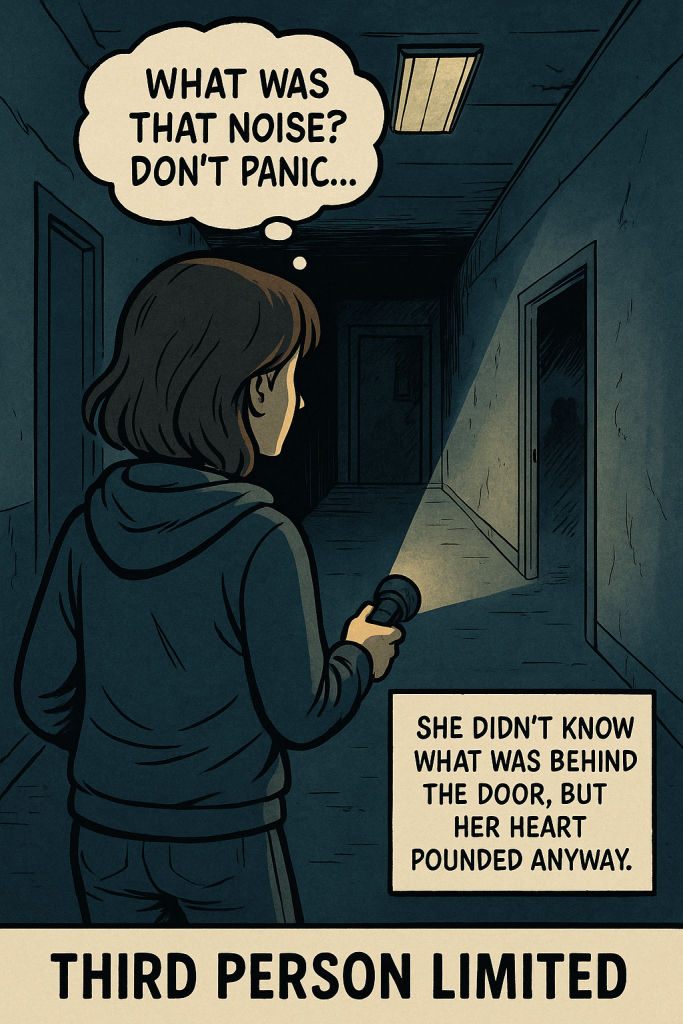
You’re not in their head, but you’re definitely looking over their shoulder.
By Jennifer Braddock – Editor
If First Person POV is “I saw the ghost,” Omniscient is “Everyone saw the ghost.” They all had strong opinions about it. Third-Person Limited is “She saw the ghost,” and regretted reading the Latin inscription aloud.
This point of view allows you to explore one character’s experience deeply. You don’t need to commit to writing as if you are them. It’s flexible, intimate, and very popular in modern fiction, especially YA, thrillers, and literary fiction.
Definition:
Third Person Limited tells the story from an outside narrator’s perspective. It uses third-person pronouns (he, she, they). However, it is limited to the thoughts, perceptions, and knowledge of one character at a time. You’re the camera, but the lens is glued to their shoulder. The POV is best for:
- Character-driven stories
- Genre fiction (fantasy, romance, mystery)
- Readers who want emotional immersion without full-on “I” narration
What Makes It Work:
- Focused insight into a single character’s thoughts and feelings.
- Suspense through selective revelation. Readers only know what the character knows.
- Empathy without total immersion. You can still write in your voice while exploring theirs.
- Flexibility to shift to other characters in different chapters or scenes. You must stay consistent within a scene.
Golden Rule of Limited:
Stick with your character’s brain. No head-hopping allowed. If you’re in Olivia’s POV, you can’t say what Jack is thinking. You can only state what Olivia guesses he’s thinking. She might be wrong, and that can be fun to play with.
- Bad: Jack looked angry. He wanted to tell her everything, but couldn’t. (How would Olivia know that?)
- Better: Jack looked angry. Olivia wondered if he wanted to tell her something, but his jaw stayed tight. (Much better, we’re in her head, not his.) Internal thoughts are often italicized or made clear with free indirect style: Why was he lying? He didn’t even flinch.
Already writing in First Person and want more flexibility? Third Person Limited lets you but zoom out just enough to expand the world a little. It’s like switching from GoPro to a handheld Digital Single Lens Reflex camera.
Next time, we’ll get godlike with Third Person Omniscient. We will explore what happens when the narrator knows everything. This includes the stuff the characters don’t want revealed.
Do you have questions or comments? Ask Besty Bot about the writing craft and how to publish your book with Best Chance Media!
Copy and Share This Post on Your Social Media:
🧠 Third Person Limited = in their mind, not in their mouth. A great POV when you want depth without diary entries. #POVWriting #WritersCommunity #ThirdPersonLimited https://bestchancemedia.org/2026/01/29/mastering-third-person-limited-pov-in-fiction/
Discover more from Best Chance Media
Subscribe to get the latest posts sent to your email.
Published by Alan O’Hashi, Whole Brain Thinker
I’ve been involved with community journalism since 1968 when I wrote for my junior school paper, the "Tumbleweed," through high school and college and then wrote for the "Wyoming State Journal." I put aside my newspaper pen and began Boulder Community Media in 2005. There wasn’t much community journalism opportunity, so I resurrected my writing career as a screenwriter. My first short screenplay, “Stardust”, won an award in the 2005 Denver Screenwriting Center contest. I've made a number of movies over the years. Filmmaking is time-consuming, labor and equipment intensive. I recently changed my workflow to first write a book and make a movie based on that content.
- Electric Vehicle Anxiety and Advice - This is a memoir travelogue of three trips covering 2,600 EV miles around Wyoming (2022)
- Beyond Heart Mountain - Winter Goose Publishers released my memoir in February (2022)
- The Zen of Writing with Confidence and Imperfection - This is a book recounting how luck planed into my signing a book deal after a 15-minute pitch meeting. (2020)
- True Stories of an Aging Baby Boomer - War stories about living in a cohousing and lessons others can learn when starting their communities (2021)
- Beyond Sand Creek - About Arapaho tribal efforts to repatriate land in Colorado (PBS - TBA)
- Beyond Heart Mountain - Based on my memoir about my childhood in Cheyenne facing overt and subtle racism toward the Japanese following World War II (PBS - 2021)
- New Deal Artist Public Art Legacy - About artists who created work in Wyoming during the Great Depression (PBS - 2018)
- Mahjong and the West - SAG indie feature which premiered at the semi-important Woodstock Film Festival (2014)
Over the years, I’ve produced directed, filmed and/or edited several short movies, “Running Horses” (Runner Up – Wyoming Short Film Contest), “On the Trail: Jack Kerouac in Cheyenne” (Lowell Celebrates Kerouac Festival, Top 10 Wyoming Short Film Contest), “Gold Digger” (Boulder Asian Film Festival), “Adobo” (Boulder International Film Festival), “A Little Bit of Discipline” (Rosebud Film Series), and two feature length documentaries “Your Neighbor’s Child” (Wyoming PBS and Rocky Mountain PBS), and “Serotonin Rising” (American Film Market, Vail Film Festival). He also directed and produced the award winning stage play “Webster Street Blues” by my childhood friend Warren Kubota.
Boulder Community Media is a non-profit production company dedicated to democratzing media in all their forms - large and small screens, printed page and stage by providing sustainable and community-based content.
I mostly work with community-based media producers, organizations, and socially-responsible businesses to develop their content via – the written word, electronic and new media, the visual and performing arts in a culturally competent manner – I’m what’s commonly called a niche TV and movie producer.
Along with all this is plying my forte’ – fund development through grant writing, sponsorship nurturing and event planning.
View all posts by Alan O’Hashi, Whole Brain Thinker