Turning Rejection into a Book Deal

By Jennifer Braddock – Editor

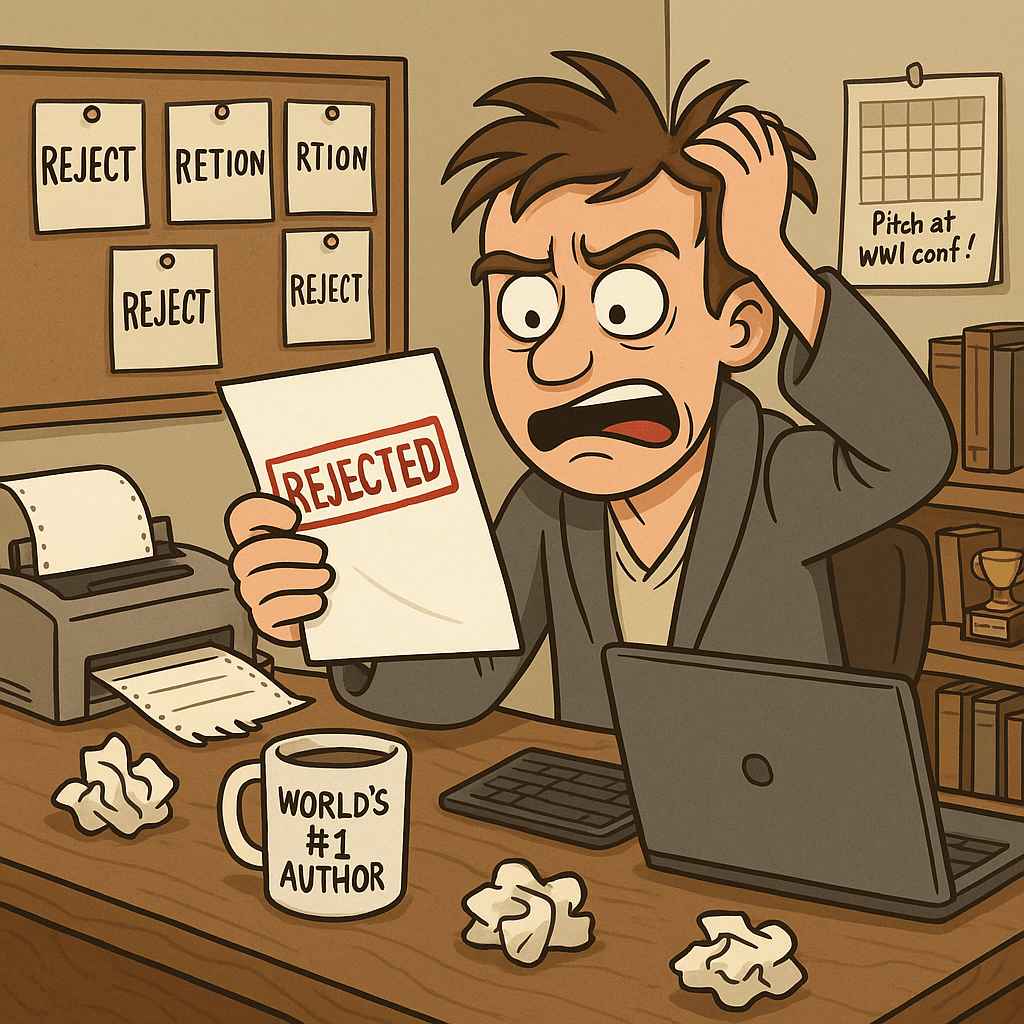
I received my first rejection letter in 1987. It was polite. The envelope looked steam-opened. Whoever did it wasn’t even that curious.

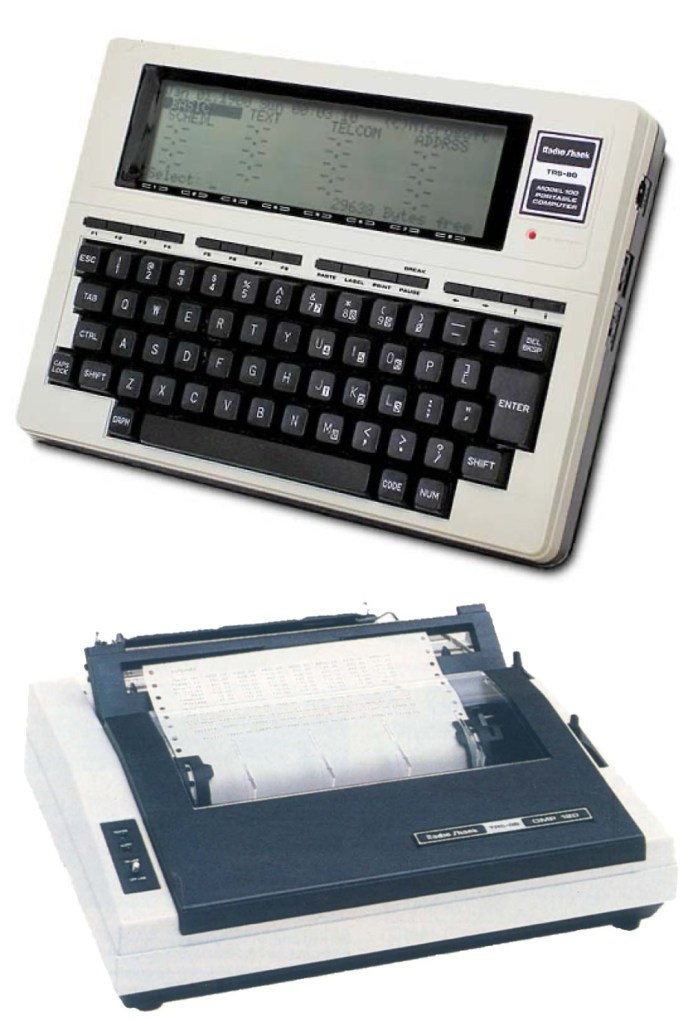
My manuscript? Printed on a dot matrix printer from a Tandy TRS-80 Model 1 back when computers sounded like dial-up demons.

My rejected pages went into a box filled with high school trophies, college memorabilia, and expired dreams.


Fast forward a few decades. Before I attended the 2019 Wyoming Writers, Inc. conference in Laramie, that rejection was still my only one. I know, it’s a unicorn story, but stick with me.

Back in the day, my Uncle Jake ran Pioneer Printing in Cheyenne. I edited Wyoming Graffiti, an anthology of newspaper columns I’d written about Wyoming and its culture. The writings included a piece titled, Beyond Heart Mountain. It was about a Japanese American woman I met on a plane from Denver to Riverton. She was interned at the Heart Mountain camp and was flying to Worland for a family get-together. It was also a throwback to my childhood growing up in the once-vibrant Japanese neighborhood of my hometown.

Years passed. Life happened. Then, I watched a local TV interview about the Japanese community in Cheyenne nudged my memory. I dusted off those old essays. They still held power.

At the WWI conference, I pitched the idea to Wintergoose Publishing. Not only did they not reject it—they accepted it on the spot. I wrote 80,000 words by October and had a contract in November.

I’ll be the first to say that this is not the norm.

Writers in online groups talk about 60, 70, 100+ rejections. Publishing can feel like playing whack-a-mole in the dark. So how do you increase your odds of success?

Put yourself in positions to succeed: Writing is solitary, but success isn’t. Go to readings. Attend writing conferences (especially ones with pitch sessions). Show up at art events, gallery openings, and open mics. Say “yes” more often. Relationships matter. Sometimes more than the perfect manuscript. People remember people.

Your odds improve when people can connect your face to your voice, and your voice to your work.

Get off the couch: Dig out your dot matrix pages. Check your iPhone Notes app scribbles. Look at your coffee-stained drafts—and get out of the house. You’re not just building a book. You’re building a network, a reputation, and maybe, if you’re lucky, a “yes” that changes everything. Rejection isn’t the end. It’s just a reroute. Success doesn’t always knock. Sometimes you have to knock first.

Get writing. Get pitching. Get out there.

Do you have questions or comments? Ask Besty Bot about the writing craft and how to publish your book with Best Chance Media!

Copy and Share This Post on Your Social Media:

📚 My first rejection? 1987. The manuscript typed on a TRS-80 and printed on a dot matrix printer. It took hours to print. Brutal. Fast forward to 2019: I pitched my old idea at a writing conference. I landed a book deal on the spot. 💡 Writing doesn’t happen in a vacuum. Show up. Speak up. Pitch your story. 📦 That box of dusty pages? It might just be your next book. #WritersLife #RejectionToRedemption #WritingCommunity #PitchToPublish #WritersConference #KeepWriting #AuthorJourney #WyomingWriters #AmWriting #NetworkingMatters #WriteYourStory #BookDealDreams https://bestchancemedia.org/2025/12/18/from-a-dot-matrix-manuscript-to-book-deal-how-i-turned-rejection-into-redemption/

Go back

Your message has been sent

Warning
Warning
Warning
Warning.

Mastering Turning Points in Storytelling

By Jennifer Braddock – Editor

Ever read a story or watch a movie where nothing really happens? Where characters meander through scenes, conversations trail off, and by the end of the chapter, you’re still not sure why you read it? That’s the danger of a story without turning points.

Whether you’re plotting meticulously or flying by the seat of your pants, knowing how and when to shift the direction of your story can keep readers engaged and keep you from getting stuck.


What Is a Turning Point?
A turning point is the moment something changes: an emotional pivot, a decision made, an accident, or a revelation. It doesn’t have to be huge. A character forgetting the bathroom code and getting locked out in a moment of crisis can be just as pivotal as finding out their partner is cheating or the plane is about to crash. Big or small, the point is: the story should never stay still.

When your character says “yes” to something, whether that’s a job, a relationship, a journey, or a truth, the scene needs to end, pivot, or reveal consequences. Unless that “yes” leads to a new challenge or reversal, the scene is over. It’s time to cut and move to the next setup.

Small Turning Points Matter
If your story feels sluggish, ask: What’s changing in this scene? What’s the point of this moment?

  • Did your character forget their lines in a school play? That’s a moment of embarrassment that could change their confidence.
  • Did a dog bark at them in the street? Maybe that moment triggers a memory.
  • Did they get a “yes” from a job interview? Great. What does that decision force them to face?

The story should always move. There are four essential turning points.


The Inciting Incident: The first major turning point is the moment that upsets your character’s ordinary world. It’s the spark. Your character gets fired, gets dumped, discovers a secret, gets an invitation they can’t refuse, or gets For example: by a spider. The incident forces them to make a choice or react.

  • A woman opens a letter meant for someone else and learns her boss is lying about her.
  • A teen forgets their backpack and ends up on a different bus that changes their life.
  • A chef drops a fork, and a customer picks it up, the first spark of a love story.

These are all small events that open the door to a bigger story.


End of Act I: This is the point of no return where the character steps fully into the story. Maybe they lie to protect someone, and now they’re stuck in the lie. Maybe they say yes to an opportunity but realize it comes with serious risks. This moment defines the rest of the story.

From there, each turning point should push the character toward the climax—the biggest turning point of all, where change becomes permanent, and the story can go no further.

Story Climax: The climax is the highest point of tension in your story: emotionally, physically, or both. It’s when your character faces the biggest challenge, makes the ultimate decision, or comes to a painful truth. After this moment, the story can go no further.

The inciting incident, the end of Act I, and every small and large turning point lead to this. It’s the do-or-die, speak-now-or-forever-hold-your-peace, win-or-lose beat.

Examples:

  • A character finally confesses their secret—and risks everything.
  • The hero defeats the villain, but at great cost.
  • A daughter walks away from her family, knowing she won’t come back.

Once the climax happens, there’s no need to keep building tension. The job now is to land the emotional plane, tie up loose ends, show the fallout, and let the reader breathe again. Let the end of your story ring and echo. Then wrap it up with a purpose rather than dragging your story out.

Denouement: Once the climax hits, the reader needs a moment to breathe. That’s why the denouement is important, as the final stretch where the consequences of the climax play out and the emotional arcs come full circle.

This is not the time to introduce new twists or subplots. Think of it as the last few moments after the storm has passed:

  • The hero limps home.
  • The lovers decide whether to try again.
  • The family gathers around a dinner table that’s a little quieter but somehow stronger.

A good denouement answers lingering questions, shows how the world has changed, and gives your readers time to reflect. It’s the moment the character relaxes, looks at the horizon, and we know at that point that after all they’ve been through, they’ll never be the same.

Without it, the climax feels abrupt. With it, your story resonates.

Plotters vs. Pantsers: Turning Points Matter Either Way
Whether you outline every beat or discover the story as you write, keeping turning points in mind will help you stay on track. Don’t write to fill pages, write to shift the stakes. Every scene should have a before and an after. Something happens. A choice is made. A secret is revealed. A bus pulls out.

Your Call to Action!
Don’t get stuck, keep moving. When you hit a wall, look for a turn. Ask: What hasn’t changed yet? What needs to? Turning points don’t have to be explosions. They can be dropped forks, forgotten codes, or missed buses. What matters is that something shifts emotionally, physically, or in the plot. Keep those turns coming, and your story will never stall.

Revisit your draft. Look at each scene and ask, “What changes here? Where’s the turn?” Keep the motion going, and you’ll find your way from start to finish—without getting stuck in the middle.

Do you have questions or comments? Ask Besty Bot about the writing craft and how to publish your book with Best Chance Media!

Copy and Share this Post on Your Social Media:

🚨 Stuck in the middle of your story? You might be missing a turning point. Every scene should shift something: an emotion, a choice, a direction. Whether it’s a dropped fork or a life-changing “yes,” something must change.

✍️ Inciting incident? That’s your spark.
🎬 End of Act I? That’s your no-turning-back point.
🏁 Climax? That’s the final pivot before the end.

Whether you’re an outliner or a pantser, turning points are your best friend. Keep the story moving. Don’t write in circles, write to change. #WritingTips #StoryStructure #TurningPoints #AmWriting #FictionWriters #WritersOfInstagram #PlotTwist #KeepWriting #PantsersAndPlotters #WriteToChange https://bestchancemedia.org/2025/12/04/from-fork-drops-to-life-flops-writing-turning-points-that-keep-stories-moving/

Mastering Short-Form Writing: Essential Strategies

By Jennifer Braddock – Editor

Would-be writers are sipping matcha at the bohemian coffee shop. Laptops are open as they write their latest piece. This piece may or may not actually exist outside their heads.

If you’re seriously considering becoming a short-form magazine writer, here’s what you can do. Make it a stopgap job while you work on the Great American Novel. Start by moving beyond the yoga café daydream. Focus on transitioning into paying work.

Think beyond “I want to write.”

Write a Business Plan:

Build a Portfolio Before You Pitch: Magazine publishers, whether glossy print or digital, want proof. They need to see that you can deliver clean, on-point writing. Get that first byline someplace, somewhere.

  • Local publications: Neighborhood papers, city lifestyle mags, or regional travel guides.
  • Nonprofit newsletters: Many will be thrilled to give you a byline in exchange for volunteer writing.
  • Online guest posts: Even unpaid, these give you links you can show editors.
    Your goal: a handful of well-edited, published clips to link in your pitch emails.

Consider Medium and Substack, but Know the Costs: Self-publishing platforms offer writers space to write and publish their work. They can also earn a little cash for their efforts.

  • Medium: You can post for free, but to earn from the Partner Program, you’ll need a paid membership. This is currently around $5 per month. The first step is attracting at least 200 followers. After that, you’ll make money based on the time members spend reading. Not exactly rent money unless you build a following.
  • Substack: There is no fee to publish. They take a 10 percent cut of subscription revenue. They also charge credit card processing fees (around 3 percent). This means if you charge $5/month, you’re netting around $4.25 per subscriber.

These platforms won’t magically bring you readers. You’ll have to actively promote your work. As with all self-publishing, having a large number of social media followers is a big help.

Develop a Short-Form Skill Set: Short-form magazine writing isn’t the same as writing essays or blog rants. You’ll need to do some research.

  • Follow the magazine’s style guide. If they say one-inch margins, make one-inch margins.
  • Nail the hook in the first sentence. This is true for any writing, but more important if you’re limited to 500 words.
  • Keep to strict word counts. If they say no more than 800 words, stick to that limit.
  • Fact-check like your career depends on it, because it does. Watch a movie called Shattered Glass, which is about the worst possible scenario of stories based on made-up facts.

Have a Safety Net: Creative entrepreneurship isn’t for wimps. Get a part-time job, ask your grandmother for a float from your inheritance, leverage your unemployment benefits, anything. You’ll deal with all kinds of excuses from publishers.

  • Late payments.
  • Kill fees. Publishers may pay you less than promised if they decide not to accept your piece.
  • Pitch rejections that read like “We’ll keep your idea in mind. That translates to “No.

Treat freelancing like a business, not a hobby.

Bottom line: Becoming a creative entrepreneur is like climbing the Flatirons in a windstorm. Have a safety net, a business plan, and a clear-eyed view of how you’ll make your writing pay. It’s not enough to just look like a writer. You’ve got to deliver the words.

If you have questions or comments, message Besty Bot. We’re always learning something new!

Copy and Share this Post on Your Social Media

Want to write magazine articles as a side hustle? You can’t swing your yoga mat without hitting someone who calls themselves a “freelance writer.” 🧘‍♀️✏️ But turning that latte-fueled dream into paying magazine work takes more than a laptop and vibes. Build your portfolio, know the platforms, and have a safety net. Creative entrepreneurship isn’t for wimps. 💪📚 https://bestchancemedia.org/2025/11/27/mastering-short-form-writing-essential-strategies/ #FreelanceWriting #WritersLife #BoulderLife #CreativeEntrepreneur #WritingTips #ShortFormWriting #MagazineWriter #ContentCreation #BusinessOfWriting #WritersCommunity #WriteAndThrive

Go back

Your message has been sent

Warning
Warning
Warning
Warning.

Exploring Healthcare Misadventures in Reverse

A lifetime of healthcare misadventures, told backwards: Read A Twinkle at the End: Rewinding My Life Through America’s Healthcare Maze now, before the author rewinds completely.

Most memoirs start with childhood and end with death. Author Alan O’Hashi does the opposite: He begins as an old guy on the verge of collapsing in the kitchen. He then works his way backward through Medicare mix-ups, acupuncture torture, and raisin-based arthritis remedies. Finally, Alan fades out as a zygote. Think about cradle-to-grave coverage in reverse.

The story begins with his healthcare in a Boulder, Colorado, senior cohousing community. Read about his acupuncture torture sessions. Discover the drunken raisin arthritis cure that nearly got him evicted from my condo for being too healthy and young.

Along the way, he recounts medical misadventures from my working life. These include a small-town hospital merger. There was also an emergency CPR rescue. From there, it’s a rewind through college scrapes, high school drama, and adolescent sex-ed horrors. There are also grade-school struggles with bad eyesight and worse teeth. Eventually, he vanishes as nothing more than a twinkle in his parents’ eyes.

Of course, there’s a paradox at the heart of all this. Healthcare providers want to keep us alive and well. To survive themselves, they depend on us being just sick enough to keep coming back. Cures don’t pay the bills, chronic conditions do.

According to Social Security, I’ve got about 10.4 years left on my warranty. Given my track record, He hopes to outlive the actuary. If you want to find out how his story unwinds before he does, grab the book now. Don’t wait until he’s a twinkle. There will be no book signings after that.

Order from Ingram iPage, ISBN: 9798218163495, Retail Price $17.99 USD.

Copy and Share this Post on Your Social Media

✨🎄 The holiday season is here, and every purchase has power! When you shop small, you support neighbors, community, and creativity. Local shops work hard to welcome you through their doors. They keep their shelves unique by carrying books and gifts from indie authors and makers. 📚🎁 This December, let’s give back to our communities. We should support shopkeepers and independent creators who make the world brighter. 💡💖 #ShopSmall #SupportLocal #IndieAuthors #HolidayShopping #SupportCreativity #BuyLocal #ReadIndie https://bestchancemedia.org/2025/11/21/exploring-healthcare-misadventures-in-reverse/

Do you have questions or comments? Ask Besty Bot about the writing craft and how to publish your book with Best Chance Media! 

Why Picking a Genre Matters More Than You Think

By Jennifer Braddock – Editor

When I first started reading about query letters, one piece of advice kept popping up: agents and publishers want to know your genre.

At first, I resisted. “My book doesn’t fit into a neat little box,” I thought. “It’s unique!” But here’s the truth: uniqueness and marketability aren’t the same thing.

I’m looking for ‘funky, magical romance’!

Think of it this way. Walk into a bookstore. What do you see? Shelves with clear labels: Mystery, Romance, Science Fiction, Memoir. If your book doesn’t fit neatly under one of those signs, where would a bookseller put it? If readers can’t find your book, or don’t know what to expect when they pick it up, they likely wont buy it.

This isn’t about stifling creativity. It’s about speaking the same language as the people who will help you get your book into readers’ hands. Agents, publishers, and booksellers all use genres as shorthand for understanding your audience.

  • Agents want to know your genre so they can decide if your book fits the kinds of projects they represent. An agent who specializes in romance won’t take on your hard sci-fi novel, even if it’s brilliant.
  • Publishers need genres because they plan book launches around clear categories. If they don’t know whether your book is a historical novel or a thriller, they can’t figure out where to market it, or which editor will champion it.
  • Readers use genre as a promise. When they pick up a mystery, they expect a crime to solve. When they buy a romance, they expect a love story. Delivering on those expectations builds trust and keeps them coming back.

Here’s a simplified way to think about it:

  1. Start broad. Is your book fiction or nonfiction?
  2. Pick a lane. If it’s fiction, is it a mystery, romance, fantasy, historical, or literary novel? If it’s nonfiction, is it memoir, history, self-help, or true crime?
  3. Drill down. Subgenres help narrow your audience. Is your fantasy epic or urban? Is your romance historical or contemporary? Is your memoir a travel memoir or a grief memoir?

Here’s the most important part: be strategic. Query agents and publishers who actually represent or publish your genre. If you have a unique hybrid subgenre, position it smartly in your query letter or pitch.

For example, you might describe your book as “a mystery with speculative elements” rather than forcing an agent to wrestle with a brand-new label. If you spend too much time explaining why your work is part this and part that, you risk sounding uncertain—and uncertainty is the fastest way to lose interest.

Another tip: think about genre before you start writing. Rather than pouring your heart into a draft and then pulling your hair out trying to shoehorn it into a category later, give yourself a boundary from the beginning. Boundaries aren’t restrictions; they’re frameworks. Knowing your story is a thriller, a romance, or a memoir helps guide your choices as you write and keeps you from drifting so far that your story doesn’t fit anywhere.

Once you know your category, you can find comp titles—books that are similar to yours in tone, audience, or subject. Comp titles aren’t about proving your book is unoriginal; they show agents, publishers, and readers where your book fits in the marketplace and why it belongs on the shelf.

So, yes, your book might straddle genres, but for the sake of selling it, you need to pick one primary genre and maybe a subgenre. Think of it as giving your book a home. After all, if you don’t know where to shelve it, how will anyone else?

Call to Action: The next time you sit down to write—or revise—ask yourself: What shelf would my book sit on in a bookstore? Start there, and you’ll save yourself countless headaches when it’s time to query, pitch, and ultimately connect with readers who are already waiting for a story just like yours.

Why Shopping Local Matters During Holidays

By Jennifer Braddock – Editor

The winter holiday season has been happening for months. Some stores put out the Halloween, Thanksgiving, Hanukkah, and Christmas decorations in October.

Time slips away faster than you can type, and the holiday hustle only accelerates. Amid the frenzy of deadlines, there is still one vital investment you can make. You can support our independent artists and local businesses.

When you choose to spend your hard-earned money within your community, you’re not just buying a book or a ticket. You are investing in the heart and soul of the neighborhood.

A Tapestry of Talent

Our local stages are alive with creativity. We see moving performances of community theater productions like our very own Christmas Carol. There are also dazzling local renditions of the Nutcracker. Independent writer book signing events and craft shows are narratives that resonate.

Musicians and dancers deliver performances that stir emotions. These emotions are stirred in ways big-budget productions rarely can. Then there are the unsung local craftspeople and artisans, whose handmade treasures add warmth and authenticity to our daily lives.

The Ripple Effect of Local Spending

Local businesses are more than storefronts; they’re community pillars. Research consistently shows that when you support local businesses, your dollars make a far greater impact. This impact is more significant than when you shop at chain stores or online giants.

For every $100 spent at a locally owned business, a significant part stays within the local economy. Often, this amount is between 60 and 70 percent. This phenomenon, known as the economic multiplier effect, results in more money for local schools. It leads to improved infrastructure and community programs. These programs further enhance our quality of life.

Large chain stores and online retailers often channel profits back to distant corporate headquarters. As a result, only a pitiful percentage of your money is reinvested locally.

By contrast, independent businesses nurture neighborhood talent, stimulate job creation, and foster economic resilience. When you buy a handcrafted ornament, you actively strengthen the community fabric. Enjoying a meal at a local bistro also contributes to this. Additionally, attending an indie art show supports the community.

Why Your Choice Matters

  • Cultural Enrichment: Independent artists bring unique perspectives that enrich our cultural landscape. Their innovation and passion add distinctive flavors to our city’s identity.
  • Economic Vitality: Keeping money local powers the “multiplier effect.” A significant percentage of your spending is reinvested into community services, local projects, and job creation.
  • Community Bonding: Local craft fairs, book signings, or a theater performance create spaces. These events allow neighbors to connect and share ideas. They offer opportunities for the community to celebrate together.
  • Sustainable Growth: Supporting local arts ensures your community remains vibrant. It also makes it diverse. This paves the way for sustainable growth that benefits everyone.

Your Call to Action

This year, as the days grow shorter and our schedules busier, take a moment to prioritize your community. Find that cozy local bookstore. Buy tickets for a local theater production. Choose an artisan’s handcrafted gift over mass-produced alternatives. Each small choice contributes to a cycle of community support and shared success.

Let your hard-earned money tell a story of hope, passion, and local pride. Stand with our independent artists and businesses. Together, we can build a richer, more vibrant community that shines even brighter during the holiday season.

Make your move: support local this holiday season and every day thereafter.

Do you have questions or comments? Ask Besty Bot about the writing craft and how to publish your book with Best Chance Media!

Copy and Share This Post on Your Social Media:

🎨🎭📚 This December, skip the mega-stores and shop where your heart lives—right in your own community. Support local authors, artists, musicians, dancers, craftspeople, and independent bookstores. 🎁 Go to the Nutcracker at the high school. Catch A Christmas Carol at your community theater. Buy a handmade ornament instead of a mass-produced one. Every dollar spent locally is a gift to your entire neighborhood. 💸❤️ #ShopLocal #SupportIndieArtists #BuyLocalArt #IndieAuthors #LocalTheater #HandmadeHolidays #SmallBusinessSeason #CommunityFirst #LocalLove #KeepItLocal #SupportTheArts https://bestchancemedia.org/2025/11/13/keep-the-spirit-alive-support-independent-artists-this-holiday-season-and-beyond/

Go back

Your message has been sent

Warning
Warning
Warning
Warning.

Unlock Your Writing Potential with Best Chance Media

By Jennifer Braddock – Editor

Best Chance Media is an imprint that seeks writers who have been rejected and not been traditionally published. If you fall through the cracks, submit anyway. We’re flexible. We only accept submissions for full-length works: at least 40,000 words: fiction, nonfiction, and memoir.

If there’s a historical element, that’s a plus.

You write romance stories or young adult fiction, and then set them in a historical context. If you’re writing a memoir, think about historical events that happened during the experience that changed your life. Fantasy and science fiction can be set in historical contexts of the earthly world.

  • Fiction: While any fiction will be checked out, we’re partial to historical fiction. The story is set in the past. It may incorporate real historical events, people, or settings. Historical stories feature fictionalized characters, dialogue, and plot details. Your story should create an authentic sense of a particular time while telling a made-up “What If?” story that fits within that historical context.
  • Nonfiction: The same applies to nonfiction. A historical story presents accounts of unique past events, people, and places, based on factual evidence and thorough research. We seek stories that describe historical events. We also explore how areas like history, philosophy, literature, art, and culture have shaped human society.
  • Memoir: Memoirs are historical by definition. They intertwine with history during significant events or periods. These include the writer’s personal story unfolding midst war, migration, or civil rights movements. Such historical events shaped the author’s journey. The memoir doesn’t just list historical facts. It brings history to life through the author’s eyes. It blends personal feelings with the realities of the time.

– The Fine Print:

  • Best Chance does not accept manuscripts that depict violence, like rape, incest, harm to a child, or dismemberment. Manuscripts that advocate criminal activity are also not accepted.
  • Best Chance only accepts manuscripts from authors who are at least 18 years old and residents of the United States.
  • Best Chance only accepts manuscripts written in English. No partial manuscripts or idea pitches will be accepted.
  • Best Chance does not accept manuscripts for foreign rights expansion into the U.S. market.
  • Best Chance does not accept earlier released books (either self-published or released by a traditional publisher).
  • Best Chance does not accept short stories, collections of stories, or poetry.
  • Best Chance will remove manuscripts that do not meet these guidelines.
  • Best Chance will remove any query directly emailed.

If you meet all the requirements, fill out the:

SUBMISSION FORM

We will let you know our decision. It may take Best Chance up to a month to accept or refuse your submission. If you have questions, send an email to bouldercommunitymedia@gmail.com

Do you have questions or comments? Ask Besty Bot about the writing craft and how to publish your book with Best Chance Media!

Copy and Share this Post on your Social Media:

Are you frustrated with all your rejection letters? Have you rewritten your story 50 times and you can’t get the interest of any agents or publishers? Best Chance Media are looking for writers like you. We’re a traditional press and won’t ask you for any upfront money, or charge you for editing. Best Chance is a writers’ cooperative that shares and collaborates for the betterment of all! https://bestchancemedia.org/2025/11/06/best_chance_submissions/

Go back

Your message has been sent

Warning
Warning
Warning
Warning.

Stay Focused: Writing Amid Holiday Chaos

By Jennifer Braddock – Editor

It’s November. You’re stirring gravy with one hand, and wrangling kids in turkey costumes with the other. Somewhere in the back of your mind, your novel is begging for attention.

School pageants and office parties are demanding your attention. You are also planning Thanksgiving dinner for twelve, plus the mysterious “plus ones.” Writing can feel like a luxury you don’t have time for.

But here’s the truth: distractions don’t take a holiday, and your writing life shouldn’t either.

How do you stay focused when the world around you smells like stuffing and chaos?

Established writing routine: Block it off on your calendar. Set a timer. Get up early. Stay up late. Whatever works. Just do it consistently.

And here’s the kicker.

Your family needs to treat this writing time like it’s your job, because it is. You’re the CEO of your story. You wouldn’t waltz into your partner’s office and interrupt their staff meeting with a question about green bean casserole. Expect the same respect for your creative business hours.

Even better? Use the holidays as story fodder. That awkward toast? That gravy explosion? The cousin who always brings his “new business venture” brochures? Pure gold. Take notes. These moments are scenes-in-waiting.

This November, don’t let your writing get sidelined by mashed potatoes and mayhem. Claim your time. Set boundaries. Write like your story depends on it—because it does.


Do you have questions or comments? Ask Besty Bot about the writing craft and how to publish your book with Best Chance Media!

Copy and Share this post on your social media:

🦃 Don’t let turkey day derail your writing goals. Claim your time and turn holiday chaos into creative gold! ✍️ #WritingThroughTheHolidays #WritersLife #ThanksgivingWriting #WritingRoutine #AmWriting #NaNoWriMoSurvival https://bestchancemedia.org/2025/10/30/from-pumpkin-pie-to-page-counts-how-to-keep-writing-through-the-holiday-madness/

Go back

Your message has been sent

Warning
Warning
Warning
Warning.

The Ultimate Guide to Successful Book Readings and Signings

By Jennifer Braddock – Editor

Your book is out in the world. Congrats, and now what? Have you dreamed of sitting at a table signing books like a literary rockstar? In that case, book readings and signings are the next logical step.

You also dream of reading your favorite passage in a hushed indie bookstore. But are they worth it? And how do you even set one up? Regardless, invite 100 of your closest friends.

Let’s break it down.

Pros of Book Readings & Signings

  • Face-to-Face Connection: Meeting readers in person can be deeply meaningful. It turns your name into a human being instead of just text on a cover.
  • Book Sales & Buzz: Yes, people do buy books at events. Even better, they post photos and tag you, giving your book legs on social media.
  • Bookstore Cold Sales: If you set up at your local bookstore. The store may buy six of your books to sell and a table. You’ll need more, so bring some of your own, and work out an arrangement with the store manager. The store can buy from you or from the publisher and be your cashier. There will likely be a table for you. Set it up by the main display at the front. All customers pass by there. Stand in front of your table and make sure to catch people’s eyes, and hand them your book.
  • Practice Makes Polished: Public readings help you hone your presentation skills. Those will be useful when you do media interviews, speak at conferences, or perform your TED Talk.
  • Community Building: Especially for indie authors, book events offer a chance to engage with local bookstores. They can connect with libraries and readers who want to support local voices.

Cons and How to Manage Them

  • Low Attendance: Sometimes, five people show up. Sometimes it’s your mom, a stranger who came for free wine, and someone lost looking for the knitting group. Solution? Market like it matters, and treat every attendee like gold.
  • Logistics Overwhelm: Booking venues, creating flyers, arranging refreshments. Event planning takes a lot of time. Solution? Partner with hosts who know what they’re doing.
  • Stage Fright: Reading aloud can feel awkward. Solution? Rehearse. Choose an excerpt with natural dialogue or emotional beats, and time it to 5–7 minutes.

How to Set One Up

  • Pick the Right Venue: Indie bookstores, libraries, writing centers, or even coffee shops. Ask if they’ve hosted authors before and what kind of support they offer.
  • Create a Simple Event Page: Use Eventbrite, your website, or a Facebook event to gather RSVPs and promote online. Bonus if the venue promotes, too.
  • Coordinate with the Host: The host (bookstore owner, librarian, or moderator) usually introduces you and may handle book sales. Provide them with your bio, book summary, and talking points in advance.
  • Plan the Flow: Keep your reading tight (5 to 7 mins), followed by a short Q&A. Then, signing time! Bring Sharpies, a stack of books, and something personal to write.
  • Capture the Moment: Take photos, record a snippet, and share. Future you will be grateful.

The Role of the Host and You

The Host:

  • Sets the tone
  • Welcomes the crowd
  • Facilitates the Q&A if needed
  • Sometimes sells books (or helps you do it)

You:

  • Reads an excerpt
  • Engages with the audience
  • Answers questions
  • Signs books and makes readers feel seen

Your Call to Action

Book events can be awkward, amazing, or both. They’re always an opportunity to connect, to practice, and to celebrate your work out loud.

Don’t wait for someone to give you permission. Book that reading, own that stage, and bring your story to life.

Got a book coming out? Start small with a pitch to your local library or indie bookstore for a reading. Need a script or event checklist? Best Chance Media can give you a hand. Contact us.

Do you have questions or comments? Ask Besty Bot about the writing craft and how to publish your book with Best Chance Media!

Copy and Share This Post on Your Social Media:

📚 Got a new book? Time to read it out loud! Pros, cons, and how to set up your first book signing event like a pro. #AuthorTips #BookLaunch #WritingCommunity #IndieAuthor #BookEvents #BookSignings #ReadingsDoneRight https://bestchancemedia.org/2025/09/11/the-ultimate-guide-to-successful-book-readings-and-signings/

Go back

Your message has been sent

Warning
Warning
Warning
Warning.


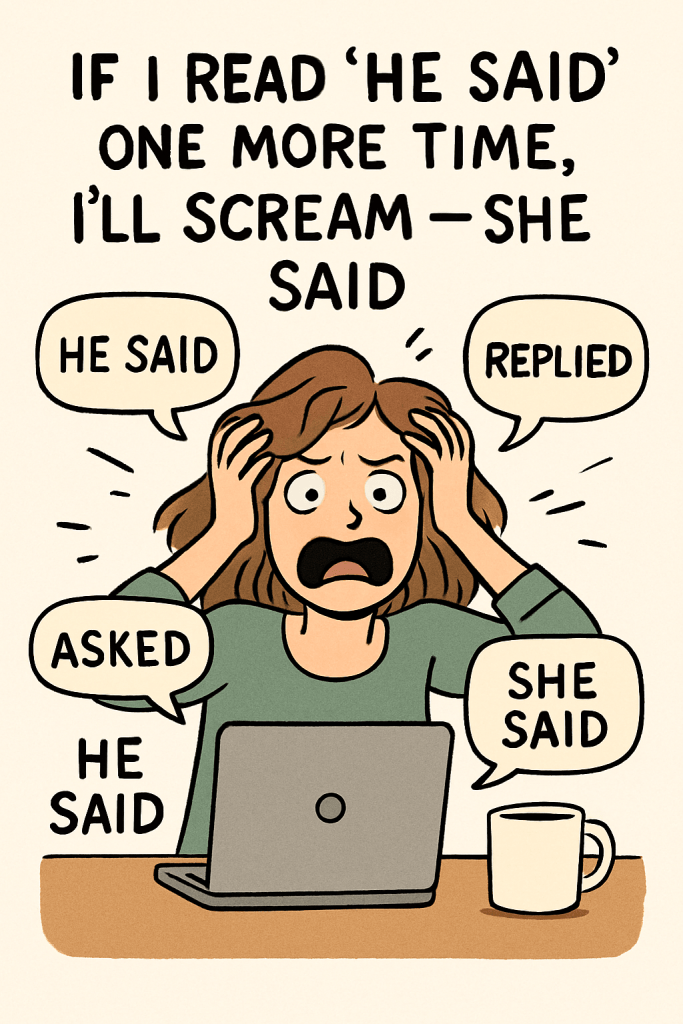
“If I read ‘He Said’ one more time, I’ll scream,” she said.

By Jennifer Braddock – Editor

Ever feel like your characters are trapped in an eternal tennis match of “he said” / “she said”? You can almost hear the ball bouncing:
“I’m leaving,” she said.
“No, you’re not,” he said.
“Yes, I am,” she said.

Yawn. Your readers didn’t sign up for a hostage situation with repetitive dialogue tags. Let’s break them out. Your mission is to hunt down those tired, overused words in your manuscript. If you choose to accept it, replace them with fresher, more engaging options. By the time we’re done, your dialogue will sparkle. Your pacing will pick up. Your beta readers will stop glazing over halfway through a page.

Step 1: Identify the Repeat Offenders

We all have comfort words we don’t even notice we’re using. Common culprits:

  • Said/replied / asked (every third line in dialogue)
  • Filler verbs: looked, turned, walked, sat, smiled, nodded
  • Filters: thought, realized, noticed, felt
  • Intensifiers: very, really, quite, suddenly

Step 2: Make Dialogue Do the Heavy Lifting

Instead of relying on endless “he said” tags, you can:

  • Use action beats: “I’m leaving.” Mara shoved her keys into her pocket.
  • Use body language: “You think I care?” Sam crossed his arms and stared at the floor.
  • Let the voice carry the tone: If the dialogue itself is distinctive, you can often skip the tag entirely.

Step 3: Search and Replace With Purpose

  1. Find each overused word.
  2. Decide if it’s needed — many can be cut.
  3. Replace with a synonym only if it feels natural. For example:
  4. “Said” could become “muttered,” “shouted,” “whispered,” or “teased.” Do not go overboard. Otherwise, you’ll end up sounding like a bad thesaurus.
  5. Read aloud — if the replacement sounds forced, try rewriting the sentence instead of swapping the word.

Step 4: Keep a Repeat Word List

Make a running list of the words you overuse. For example, if “just” appears 437 times, maybe 420 of them can go.

Step 5: Turn Editing Into a Game

Set a timer for 20 minutes. Each time you find and fix a repetitive word, tally a point. Reward yourself with chocolate, coffee, or smug satisfaction when you beat yesterday’s score.

50 Overused Words & Phrases to Hunt in Your Manuscript

Dialogue tags:

  1. Said
  2. Asked
  3. Replied
  4. Answered

Filler verbs:
5. Looked
6. Turned
7. Walked
8. Went
9. Came
10. Sat
11. Stood
12. Gave
13. Got
14. Took
15. Made

Filter words (create distance from POV):
16. Thought
17. Felt
18. Knew
19. Realized
20. Noticed
21. Saw
22. Heard
23. Decided

Weak modifiers & intensifiers:
24. Very
25. Really
26. Just
27. Quite
28. Almost
29. Nearly
30. Suddenly
31. A little
32. A bit
33. Kind of / sort of

Overused reactions:
34. Smiled
35. Laughed
36. Nodded
37. Shook head
38. Sighed
39. Frowned
40. Raised eyebrows
41. Rolled eyes

Time/transition crutches:
42. Then
43. After
44. Before
45. While
46. When
47. As
48. Again
49. Suddenly
50. Finally

Copy and Paste Post on Your Social Media:

✏️ Ever feel like your manuscript is stuck in a loop of “he said” / “she said”?
🙉 Your readers do, too. 🚀 Spice up your dialogue with action beats, body language, and voice, not just recycled tags.💡 Pro tip: Use your word processor’s “Find” tool to hunt down overused words and set your characters free! #WritingTips #AmEditing #WritersLife #IndieAuthor #WritingCommunity #DialogueTips #EditingHacks #AuthorLife #FictionWriting #WIP #WritersOfInstagram https://bestchancemedia.org/2025/10/02/if-i-read-he-said-one-more-time-ill-scream-she-said/

Do you have questions or comments? Ask Besty Bot about the writing craft and how to publish your book with Best Chance Media!

Go back

Your message has been sent

Warning
Warning
Warning
Warning.