By Jennifer Braddock – Editor
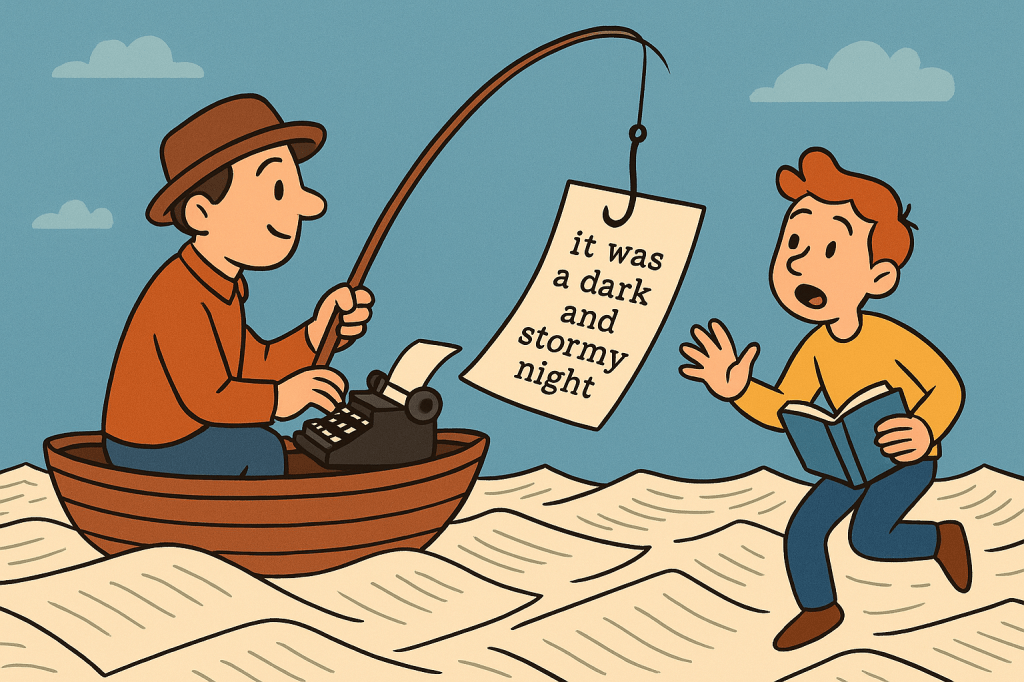
There’s an old saying in publishing: Your first page sells the book. The last page sells your next book.
In an era where readers are bombarded with e-books, podcasts, and streaming shows, capturing attention is a challenge.
Social media and endless repeats further add to the clutter. You have only seconds to convince consumers that your story is worth their time.
Beginning your first page with a catchy first line is critically important.
Whether you’re writing a novel, a memoir, or a short story, the first line is your golden handshake. It’s your sales pitch and your mood-setter all in one.
“An opening line should invite the reader to begin the story,” is what Stephen King said. Your first line sets the tone for the first page that needs to glow like a tended ember.
Why the First Page Matters: A casual bookstore browser will flip open your book and read a paragraph. That’s when they decide whether to walk to the cash register or put it back on the shelf. Agents and editors? They’re more ruthless. They read so many bad stories that they know within a few sentences whether a manuscript is worth further reading.
The first page has a tall order to fill. Be sure you:
- Grab attention immediately.
- Establish tone and voice.
- Offer a sense of the world or situation.
- Make the reader curious enough to keep turning pages.
Done well, it’s like smoldering cedar. Readers can’t help but follow where you’re leading them.
The Anatomy of a First Page Hook: Think of the first page as having three layers.
First Line, The Spark: This is your ignition switch. It can be shocking, funny, mysterious, or emotionally intense. Its job is to make the reader think, I need to know more.
- A startling statement: “The day my sister stopped speaking to me began like any other.”
- A curious image: “By the time the cat arrived, the rain had already soaked the bread on the windowsill.”
- A direct challenge: “Everything they told you about the fire was a lie.”
First Paragraph, The Tone-Setter: The first paragraph expands the spark into a flame. Here you introduce voice, hint at stakes, and begin to reveal the world your characters inhabit. It should answer at least one question: Who’s talking? Where are we? What’s happening right now? Leave enough mystery to keep readers moving forward.
First Page, The Invitation: By the end of page one, you want the reader emotionally invested in your bonfire. You also want them intellectually invested.
- Introduce a compelling character, situation, or problem.
- Show enough personality or atmosphere to suggest what kind of journey this will be.
- End with momentum, like a small cliffhanger, a hint of danger, or a hanging question.
Novels vs. Memoirs Hooks: I write memoirs and historical fiction. I’m most familiar with those. Hooks are always similar.
Similarities:
- Both need to hook readers quickly.
- Both benefit from strong voice, vivid detail, and a clear emotional tone.
Differences:
- Novels have total freedom to invent the most dramatic and intriguing moments. They can start even if it’s chronologically later in the story.
- Memoirs are bound to truth, but that doesn’t mean you must start at the very beginning. You can still open in the middle of a pivotal moment in your life and then work backward or forward.
- Memoirs rely heavily on voice. The reader needs to feel they are in good hands. The storyteller must know how to make even an ordinary moment compelling.
For a memoir, think of the first page as a promise to the reader: “Yes, this really happened. Yes, it matters. And yes, you’ll be glad you came along for the ride.”
Does Point of View Affect the Hook? Absolutely. Your POV choice shapes the intimacy, immediacy, and style of the hook.
First Person (“I”):
- Pros: Instant intimacy. Great for memoirs and deeply character-driven fiction. Let’s readers step directly into the narrator’s mind.
- Cons: Can feel claustrophobic if the narrator’s voice isn’t strong or likable.
Close Third Person (“he/she/they” with access to thoughts):
- Pros: Offers intimacy with flexibility to move between inner thoughts and outward action.
- Cons: Can be harder to establish a strong voice right away compared to first person.
Omniscient Third Person (all-knowing narrator):
- Pros: Sweeping scope, ability to set a large stage, and add irony or commentary.
- Cons: Can feel distant unless anchored in vivid, specific sensory details.
Is there a best POV for a hook? POV effectiveness depends on your story’s tone and emotional core. For maximum impact on page one, use a closer POV. A first or close third-person perspective helps the reader bond quickly with your narrator or main character. Here are examples of effective hooks.
Novel: “It was a bright cold day in April, and the clocks were striking thirteen.” (1984, George Orwell)
There’s an unsettling detail (clocks striking thirteen) that immediately signals that something is off in this world.
Memoir: “In our family, there was no clear line between religion and fly fishing.” (A River Runs Through It, Norman Maclean).
This works because the voice and juxtaposition make you want to know more about this family.
A First-Page Structure Template: Here’s a quick checklist you (or your blog readers) can keep nearby:
First Line:
- Intriguing image, surprising fact, or emotionally charged statement.
First Paragraph:
- Establish tone and voice.
- Ground the reader in time/place without over-explaining.
First Page:
- Introduce a character or situation.
- Hint at stakes or tension.
- End with something unresolved.
Final Thoughts and a Challenge: Writing a great hook is part art, part craft. The art is in knowing what emotional note you want to strike. The craft is in revising until every word earns its place.
Write three completely different first pages for the same story idea. One in first person, one in limited third, and one starting deep in the action. Read them aloud. See which one makes you most eager to keep going. Chances are, that’s the one that will work on your readers too.
Your hook’s job is simple: make readers turn the page. If you do that, you’ve already won half the battle.
Do you have questions or comments? Ask Besty Bot about the writing craft and how to publish your book with Best Chance Media!
Copy and Share this Post on your Social Media:
📚 Your first page isn’t just an introduction, it’s your audition.
Whether you’re writing a novel or a memoir, the hook is your handshake. It is your invitation and your promise to the reader. In my latest blog post, I break down:
- What makes a killer first page
- How memoir hooks differ from fiction
- Why POV changes the impact of your opening line
Copy and Share this Post on Your Social Media
✨ Don’t just start your story, ignite it. #AmWriting #WritingTips #WritersLife #WritingCommunity #AmEditing #Storytelling #BookMarketing #IndieAuthor #NovelWriting #MemoirWriting #WritersOfInstagram #AuthorLife #FictionWriting #WritingAdvice #POVWriting #FirstPageHook #ReadersLife