Mastering Turning Points in Storytelling

By Jennifer Braddock – Editor

Ever read a story or watch a movie where nothing really happens? Where characters meander through scenes, conversations trail off, and by the end of the chapter, you’re still not sure why you read it? That’s the danger of a story without turning points.

Whether you’re plotting meticulously or flying by the seat of your pants, knowing how and when to shift the direction of your story can keep readers engaged and keep you from getting stuck.


What Is a Turning Point?
A turning point is the moment something changes: an emotional pivot, a decision made, an accident, or a revelation. It doesn’t have to be huge. A character forgetting the bathroom code and getting locked out in a moment of crisis can be just as pivotal as finding out their partner is cheating or the plane is about to crash. Big or small, the point is: the story should never stay still.

When your character says “yes” to something, whether that’s a job, a relationship, a journey, or a truth, the scene needs to end, pivot, or reveal consequences. Unless that “yes” leads to a new challenge or reversal, the scene is over. It’s time to cut and move to the next setup.

Small Turning Points Matter
If your story feels sluggish, ask: What’s changing in this scene? What’s the point of this moment?

  • Did your character forget their lines in a school play? That’s a moment of embarrassment that could change their confidence.
  • Did a dog bark at them in the street? Maybe that moment triggers a memory.
  • Did they get a “yes” from a job interview? Great. What does that decision force them to face?

The story should always move. There are four essential turning points.


The Inciting Incident: The first major turning point is the moment that upsets your character’s ordinary world. It’s the spark. Your character gets fired, gets dumped, discovers a secret, gets an invitation they can’t refuse, or gets For example: by a spider. The incident forces them to make a choice or react.

  • A woman opens a letter meant for someone else and learns her boss is lying about her.
  • A teen forgets their backpack and ends up on a different bus that changes their life.
  • A chef drops a fork, and a customer picks it up, the first spark of a love story.

These are all small events that open the door to a bigger story.


End of Act I: This is the point of no return where the character steps fully into the story. Maybe they lie to protect someone, and now they’re stuck in the lie. Maybe they say yes to an opportunity but realize it comes with serious risks. This moment defines the rest of the story.

From there, each turning point should push the character toward the climax—the biggest turning point of all, where change becomes permanent, and the story can go no further.

Story Climax: The climax is the highest point of tension in your story: emotionally, physically, or both. It’s when your character faces the biggest challenge, makes the ultimate decision, or comes to a painful truth. After this moment, the story can go no further.

The inciting incident, the end of Act I, and every small and large turning point lead to this. It’s the do-or-die, speak-now-or-forever-hold-your-peace, win-or-lose beat.

Examples:

  • A character finally confesses their secret—and risks everything.
  • The hero defeats the villain, but at great cost.
  • A daughter walks away from her family, knowing she won’t come back.

Once the climax happens, there’s no need to keep building tension. The job now is to land the emotional plane, tie up loose ends, show the fallout, and let the reader breathe again. Let the end of your story ring and echo. Then wrap it up with a purpose rather than dragging your story out.

Denouement: Once the climax hits, the reader needs a moment to breathe. That’s why the denouement is important, as the final stretch where the consequences of the climax play out and the emotional arcs come full circle.

This is not the time to introduce new twists or subplots. Think of it as the last few moments after the storm has passed:

  • The hero limps home.
  • The lovers decide whether to try again.
  • The family gathers around a dinner table that’s a little quieter but somehow stronger.

A good denouement answers lingering questions, shows how the world has changed, and gives your readers time to reflect. It’s the moment the character relaxes, looks at the horizon, and we know at that point that after all they’ve been through, they’ll never be the same.

Without it, the climax feels abrupt. With it, your story resonates.

Plotters vs. Pantsers: Turning Points Matter Either Way
Whether you outline every beat or discover the story as you write, keeping turning points in mind will help you stay on track. Don’t write to fill pages, write to shift the stakes. Every scene should have a before and an after. Something happens. A choice is made. A secret is revealed. A bus pulls out.

Your Call to Action!
Don’t get stuck, keep moving. When you hit a wall, look for a turn. Ask: What hasn’t changed yet? What needs to? Turning points don’t have to be explosions. They can be dropped forks, forgotten codes, or missed buses. What matters is that something shifts emotionally, physically, or in the plot. Keep those turns coming, and your story will never stall.

Revisit your draft. Look at each scene and ask, “What changes here? Where’s the turn?” Keep the motion going, and you’ll find your way from start to finish—without getting stuck in the middle.

Do you have questions or comments? Ask Besty Bot about the writing craft and how to publish your book with Best Chance Media!

Copy and Share this Post on Your Social Media:

🚨 Stuck in the middle of your story? You might be missing a turning point. Every scene should shift something: an emotion, a choice, a direction. Whether it’s a dropped fork or a life-changing “yes,” something must change.

✍️ Inciting incident? That’s your spark.
🎬 End of Act I? That’s your no-turning-back point.
🏁 Climax? That’s the final pivot before the end.

Whether you’re an outliner or a pantser, turning points are your best friend. Keep the story moving. Don’t write in circles, write to change. #WritingTips #StoryStructure #TurningPoints #AmWriting #FictionWriters #WritersOfInstagram #PlotTwist #KeepWriting #PantsersAndPlotters #WriteToChange https://bestchancemedia.org/2025/12/04/from-fork-drops-to-life-flops-writing-turning-points-that-keep-stories-moving/

Master Self-Editing Before Hiring an Editor

By Jennifer Braddock – Editor

You typed “The End.” You’re euphoric. You’re exhausted. You’re ready to send your masterpiece off to an editor… but slow your roll, Hemingway. Drafting is just half the job.

Now comes editing. This is the tedious part that turns your messy genius into a manuscript readers won’t want to put down.

Before you hire anyone, give your manuscript a round or three or four of self-editing. You’ll save money, make your editor’s job easier, and catch obvious stuff yourself.

Self-Editing Checklist:

  • Take Your Time: Editing is a slow process. When you find that your mind is wandering. It’s time to stop. Take a break and come back later.
  • Structure: Does the story flow logically? Do scenes build tension? Are character arcs satisfying?
  • Style: Are there overused words or cliches? Do you vary sentence structure?
  • Dialogue: Does it sound natural? Does each character have a distinct voice?
  • Pacing: Are there slow spots or info dumps?
  • Continuity: Are your character’s eyes blue on page 10 and brown on page 200?

Use Tools, Not Crutches

Digital tools can be helpful, but don’t let them write your novel for you. There are limited feature free versions, but do a pretty good job. If you’re reading your words and a historical point doesn’t make sense, cross-check your information. It doesn’t matter if you use an online tool or have people give you notes, you still have to decide whether or not you want to accept the proposed changes. Run your work through these, but read every suggestion critically. Don’t let algorithms rewrite your voice.

Popular Tools:

  • Grammarly: Good for catching spelling and grammar issues, but it can kill your style if you accept every suggestion.
  • ProWritingAid: Offers style suggestions and checks for repetition and readability.
  • AutoCorrect: Great for typos, dangerous if you rely on it blindly. It only catches misspellings, not homonyms.
  • Natural Reader: Text-to-speech is a good way to hear how your words sound. You can edit while you’re listening, then copy your work back into the manuscript.

Know Your Editor Types

Different editors do different things. Hiring the wrong kind is like bringing a plumber to fix your roof.

Types of Editors:

  • Developmental Editor: Big picture stuff, like plot, structure, character arcs.
  • Line Editor: Sentence-level style, flow, and clarity.
  • Copy Editor: Grammar, punctuation, consistency, factual accuracy.
  • Proofreader: The final polish. Typos and formatting only.

When to Hire an Editor

Once you’ve self-edited and maybe gotten beta reader feedback, then it’s time to hire.

Timing Tips:

  • Hire a developmental editor early if you’re unsure about your story structure.
  • Bring in a line editor once the plot is solid and your draft is clean.
  • Use a copy editor before you submit to agents or self-publish.
  • Get a proofreader after layout or formatting is done.

Your Call to Action!
Finishing your first draft feels like crossing the finish line, until you realize you’ve just qualified for the marathon. Treat editing like a vital part of your writing process. It is not a punishment. Then, you’ll come out with a manuscript that actually earns those five-star reviews.

Ready to level up your manuscript? Start with self-edits, test-drive some tools, then find the right editor for your stage. Share this post with your writing group, and let’s raise the editing bar together.

Do you have questions or comments? Ask Besty Bot about the writing craft and how to publish your book with Best Chance Media!

Copy and Share this post to your social media:

📚 You finished your draft—congrats! But don’t hire an editor just yet.
First, self-edit like a boss. Then choose the right editor for the job. Not sure where to start? This post breaks it all down—tools, timing, and types of editors you actually need.✍️
https://bestchancemedia.org/2025/11/20/so-you-think-youre-done-a-writers-guide-to-editing-before-you-hire-an-editor/

#AmEditing #WritingTips #IndieAuthorLife #SelfEditing #EditingTips #Grammarly #ProWritingAid #WritersOfInstagram #WritersCommunity #FinishTheDraft #WritingJourney #HireAnEditor

Go back

Your message has been sent

Warning
Warning
Warning
Warning.

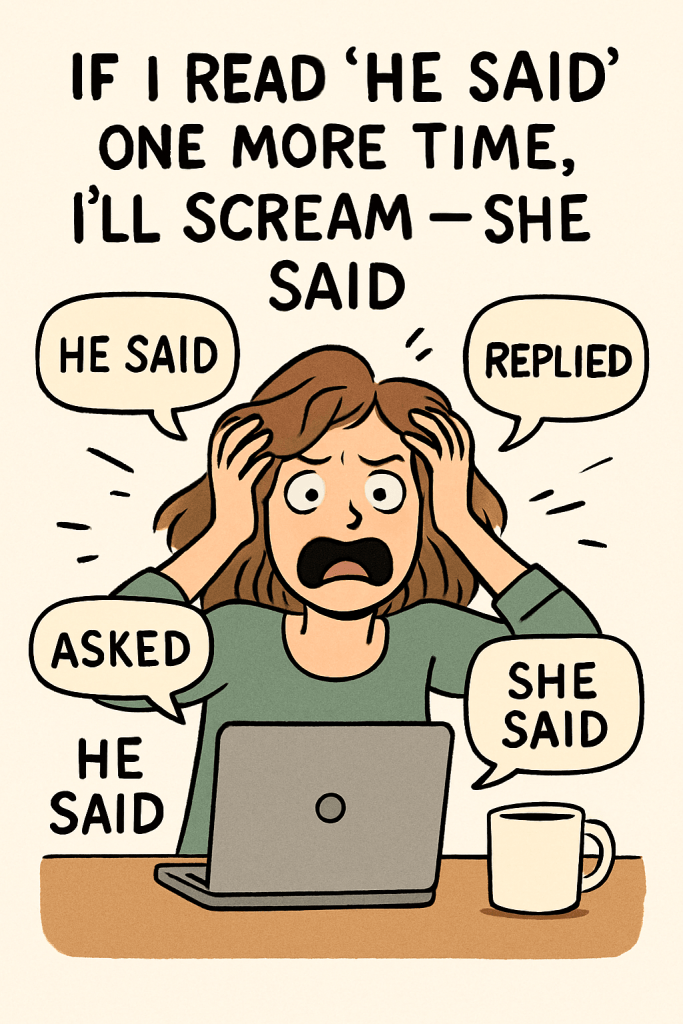
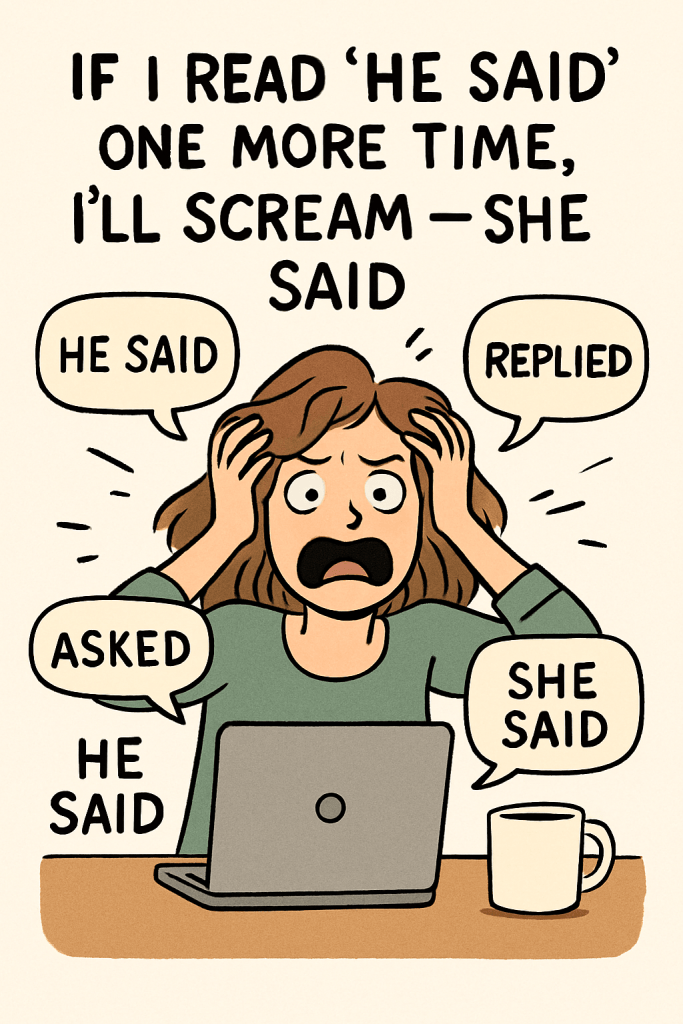
“If I read ‘He Said’ one more time, I’ll scream,” she said.

By Jennifer Braddock – Editor

Ever feel like your characters are trapped in an eternal tennis match of “he said” / “she said”? You can almost hear the ball bouncing:
“I’m leaving,” she said.
“No, you’re not,” he said.
“Yes, I am,” she said.

Yawn. Your readers didn’t sign up for a hostage situation with repetitive dialogue tags. Let’s break them out. Your mission is to hunt down those tired, overused words in your manuscript. If you choose to accept it, replace them with fresher, more engaging options. By the time we’re done, your dialogue will sparkle. Your pacing will pick up. Your beta readers will stop glazing over halfway through a page.

Step 1: Identify the Repeat Offenders

We all have comfort words we don’t even notice we’re using. Common culprits:

  • Said/replied / asked (every third line in dialogue)
  • Filler verbs: looked, turned, walked, sat, smiled, nodded
  • Filters: thought, realized, noticed, felt
  • Intensifiers: very, really, quite, suddenly

Step 2: Make Dialogue Do the Heavy Lifting

Instead of relying on endless “he said” tags, you can:

  • Use action beats: “I’m leaving.” Mara shoved her keys into her pocket.
  • Use body language: “You think I care?” Sam crossed his arms and stared at the floor.
  • Let the voice carry the tone: If the dialogue itself is distinctive, you can often skip the tag entirely.

Step 3: Search and Replace With Purpose

  1. Find each overused word.
  2. Decide if it’s needed — many can be cut.
  3. Replace with a synonym only if it feels natural. For example:
  4. “Said” could become “muttered,” “shouted,” “whispered,” or “teased.” Do not go overboard. Otherwise, you’ll end up sounding like a bad thesaurus.
  5. Read aloud — if the replacement sounds forced, try rewriting the sentence instead of swapping the word.

Step 4: Keep a Repeat Word List

Make a running list of the words you overuse. For example, if “just” appears 437 times, maybe 420 of them can go.

Step 5: Turn Editing Into a Game

Set a timer for 20 minutes. Each time you find and fix a repetitive word, tally a point. Reward yourself with chocolate, coffee, or smug satisfaction when you beat yesterday’s score.

50 Overused Words & Phrases to Hunt in Your Manuscript

Dialogue tags:

  1. Said
  2. Asked
  3. Replied
  4. Answered

Filler verbs:
5. Looked
6. Turned
7. Walked
8. Went
9. Came
10. Sat
11. Stood
12. Gave
13. Got
14. Took
15. Made

Filter words (create distance from POV):
16. Thought
17. Felt
18. Knew
19. Realized
20. Noticed
21. Saw
22. Heard
23. Decided

Weak modifiers & intensifiers:
24. Very
25. Really
26. Just
27. Quite
28. Almost
29. Nearly
30. Suddenly
31. A little
32. A bit
33. Kind of / sort of

Overused reactions:
34. Smiled
35. Laughed
36. Nodded
37. Shook head
38. Sighed
39. Frowned
40. Raised eyebrows
41. Rolled eyes

Time/transition crutches:
42. Then
43. After
44. Before
45. While
46. When
47. As
48. Again
49. Suddenly
50. Finally

Copy and Paste Post on Your Social Media:

✏️ Ever feel like your manuscript is stuck in a loop of “he said” / “she said”?
🙉 Your readers do, too. 🚀 Spice up your dialogue with action beats, body language, and voice, not just recycled tags.💡 Pro tip: Use your word processor’s “Find” tool to hunt down overused words and set your characters free! #WritingTips #AmEditing #WritersLife #IndieAuthor #WritingCommunity #DialogueTips #EditingHacks #AuthorLife #FictionWriting #WIP #WritersOfInstagram https://bestchancemedia.org/2025/10/02/if-i-read-he-said-one-more-time-ill-scream-she-said/

Do you have questions or comments? Ask Besty Bot about the writing craft and how to publish your book with Best Chance Media!

Go back

Your message has been sent

Warning
Warning
Warning
Warning.