Embracing Your Truth: The Art of Memoir Writing

When you sit down to write about your life, you might wonder: Is this a biography or a memoir?
The difference is more than just page count. A biography tells the full sweep of a life from birth to death, often told chronologically, fact-checked, and complete. A memoir, on the other hand, zooms in on a particular slice of your life. It explores a theme or thread that connects the moments you choose to share.

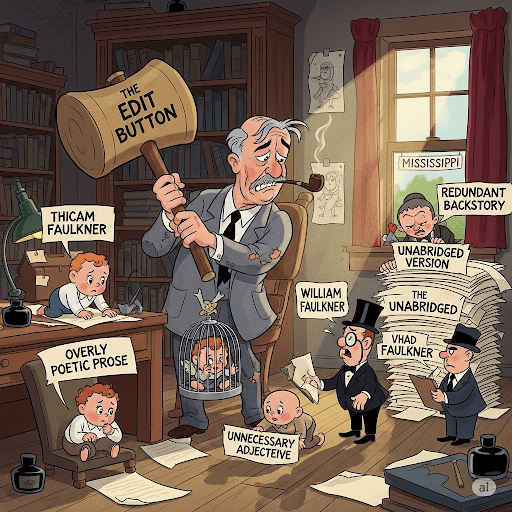
Here’s the thing: you can have more than one memoir. William Faulkner’s oft-quoted advice to “kill your darlings” means you must be willing to cut the parts of your work. These may be parts you personally love the most. As a writer, this can be challenging.

You need to be ready to remove these elements. They could be a clever phrase or a beautifully crafted sentence. Sometimes, it’s even an entire subplot. Remove them if they don’t serve the story as a whole.

The “darlings” are those bits you’re emotionally attached to, but which distract, slow down, or confuse the reader. Faulkner’s point is that good writing is about clarity. It is also about cohesion and the reader’s experience. It is not about the writer’s sentimental attachment to certain lines.

Your darlings may not be needed now, but stash them in the basement for your next project. Larry David and Woody Allen keep notebooks with sentences they overhear or incidents they experience for future reference.

Write freely, but edit ruthlessly. If it doesn’t serve the story, let it go. Rather than “kill your darlings,” keep nurturing them in the guest room until they become relevant for another story.

Life is made of many threads. I wrote Beyond Heart Mountain. It started as a newspaper column. The column was about the lingering shadow of subtle and overt racism toward Japanese Americans after Pearl Harbor. Those echoes have shaped me to this day.

I also wrote A Twinkle at the End. It’s my story of rising from the deathbed. I weave that experience into my decades of navigating the health care system.

Different slices, different truths, both memoirs.

The story in Beyond Heart Mountain began as deeply personal. I realized my experiences weren’t mine alone. I aimed to make my personal story useful to people. I placed it into a broader social context. I hoped this would make it relatable to the general public.

Same with A Twinkle at the End. Many people have faced death in a hospital. I chose to incorporate that experience into my perspectives on health care, which is an important topic these days.

I was offered a publishing contract for Beyond Heart Mountain after my first pitch. That strange sequence of events planted the seeds for a third memoir. The Zen of Creative Imperfection is about my unorthodox writing journey. I’ll update that book with all these stories about the writing craft I’ve been composing.

You are thinking about writing a memoir or trying to write one. If you find yourself stuck or avoiding it because vacuuming is more important, you are dodging your truth. I wrote about this in my post on knowing yourself and Ernest Hemingway’s “one true sentence.” Your job is to tell the clearest, most honest thing you can. Do this one line at a time.

The beauty of memoir is that it doesn’t require you to tell everything. It only requires you to share the truth of what you choose. You can focus on the moments that matter most. These moments illuminate both your life and a universal human experience.

Resurrect your cast-off darlings for another memoir.

If your story’s been knocking on the door of your mind, answer it. Put down the remote. Get off the couch. Write that one true sentence, and the rest will follow.

Do you have questions or comments? Ask Besty Bot about the writing craft and how to publish your book with Best Chance Media!

← Back

Thank you for your response. ✨

Embrace Authenticity in Writing: The Power of True Stories


By Jennifer Braddock – Editor

Let’s face it. If you’re a writer, and your most “authentic” story involves flipping an egg, you should consider exploring more complex topics.

It might be time to dig up the messy stuff. Are you just staring at a blank screen or a notebook page?

You know, like that one time you were caught shoplifting and the cop made you own up to your dad. Remember when you almost got cast as “Man in Crowd #256? You didn’t answer the casting director’s call. You thought it was a spam number.

Don’t worry.

“All you have to do is write one true sentence,” Ernest Hemingway said.

Authenticity matters more than polish

Polish can make your writing look good, but authenticity makes it mean something. Readers can sense when you’re putting up a front or trying too hard to impress with overly interesting descriptions. They’ll nod politely and move on to the next book.

When you tell the truth, your voice might crack. Your story might stumble. Your guard might drop. That’s when people get hooked. Perfect writing might win awards, but authentic writing wins hearts. When you combine the two, that’s what keeps readers coming back, not to admire your prose, but to feel something real.

Readers crave connection, not perfection

Perfection is intimidating. Connection is comforting. Do you identify more with the person who never makes a mistake, or do you relate to the one who dribbled a Coke down their shirt before a big presentation?

Readers want to see themselves in your story: their fears, mess-ups, and the small triumphs. If you try to make yourself the flawless hero, you shut people out. When you share your struggle, you invite them to be a part of your story. In a world filled with filtered selfies and curated feeds, your raw honesty stands out. It is the most refreshing thing they will have read all day.

Your most embarrassing stories are your most relatable

That time you accidentally called your teacher “Mom”? or said “I love you” to a customer service rep? Those moments you wish you could delete are storytelling gold. Why? Because we’ve all been there: humiliated, awkward, and unsure. Those memories feel awful in the moment. Yet, they’re the ones that make people laugh, cry, and say, “Oh my gosh, me too.”

If you’re brave enough to tell the story, someone out there is waiting to read it. They want to feel a little less alone.

Every failure, regret, and awkward moment is a secret gold mine

Behind every “I blew it” is a potential breakthrough in your writing and in your life. Failure teaches us what success never will.

Regret reveals our values. Awkwardness strips away ego. These moments are obstacles and building blocks. Don’t run from them. Use them. Write turning points into chapters. Write honestly about what went wrong, and with a sense of humor transforms shame into strength. It’s not about glorifying the stmble. It’s about showing how you got back up and on your feet.

Fiction is great, but truth punches harder

There’s power in fiction, but even the most fantastic stories hit hardest when they echo something true. We weep over made-up characters because their pain feels real.

When your writing comes straight from experience, it lands with more impact. Your lived truth doesn’t need embellishment. Tell it with bravery.

Your voice is more compelling than anything you dream up. It is shaped by the sweet, the bitter, the bizarre, and everything else you’ve experienced.

Dig deep for your truth

Your life is a ragtag scrapbook of shining and cringe-inducing moments, not a flawless resumé. Own them. Write them. Your one true sentence might start with a terrible haircut, a missed opportunity, or a mistake you thought you’d buried.

Dig deep, be brave, and stop trying to airbrush away your bad experiences. Your truth is your voice. It’s what readers remember long after the last page.

At the end of the day, writing isn’t about sounding smart or looking impressive. It’s about telling the truth, even when your voice shakes.

Hemingway wasn’t asking us to be profound. He wants us to be honest. One true sentence. Your truth might come wrapped in awkwardness, heartbreak, or absurdity. Your true sentence is what makes your writing believable and powerful. Stop waiting for the perfect idea or the polished version of yourself. Dig deep. Say the things you’ve been scared to say. Start with one true sentence. The rest will follow.

Do you have questions or comments? Ask Besty Bot about the writing craft and how to publish your book with Best Chance Media!

Copy and Share This Post on Your Social Media:

✍️ Hemingway said to write one true sentence. That’s it. Not the perfect sentence. Not the impressive one. Just the real one. Your most embarrassing, awkward, even painful stories? They’re your most powerful. Don’t polish the truth out of them. Start with honesty — and let the story unfold from there. 💬 #WriteYourTruth #OneTrueSentence #AuthenticWriting #WritersLife #INFPwriter #RealStoriesMatter #MemoirMoments #WriteToConnect #MessyIsMeaningful #TruthBeTold https://bestchancemedia.org/2025/09/04/embrace-authenticity-in-writing-the-power-of-true-stories/

← Back

Thank you for your response. ✨