By Jennifer Braddock – Editor
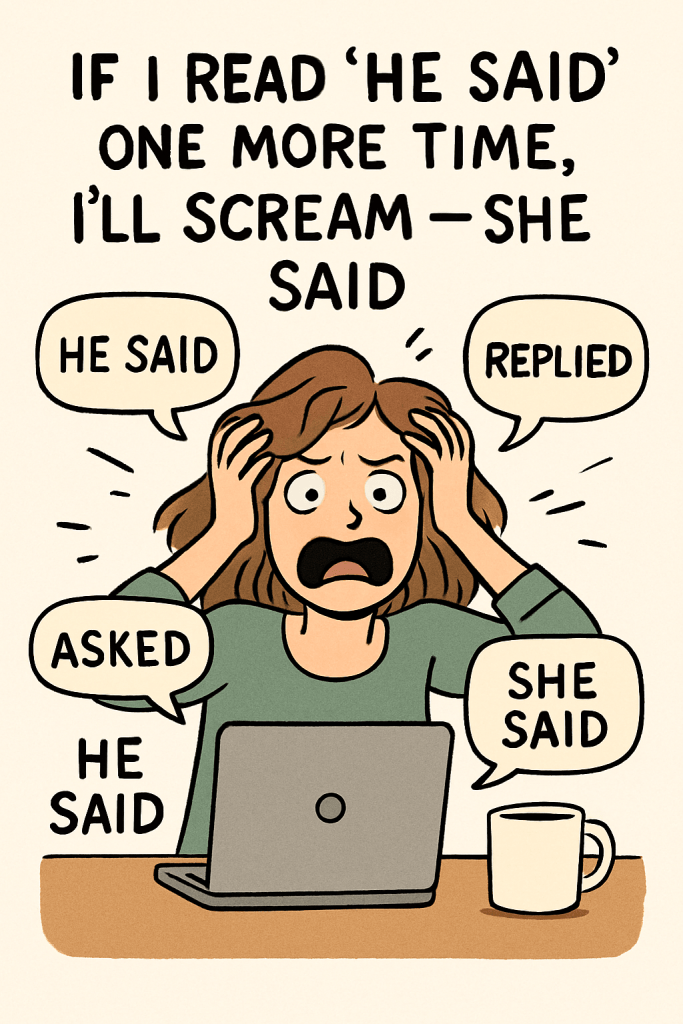
Ever feel like your characters are trapped in an eternal tennis match of “he said” / “she said”? You can almost hear the ball bouncing:
“I’m leaving,” she said.
“No, you’re not,” he said.
“Yes, I am,” she said.Yawn. Your readers didn’t sign up for a hostage situation with repetitive dialogue tags. Let’s break them out. Change the conversation to move the story ahead by showing, and not telling:
“I’m leaving.” She stormed out the door and instantly returned when she walked into a rainstorm.
“No, you’re not!” He grabbed and unfurled an umbrella.
“Yes, I am.” She pulled up her collar and the two walked out together under the umbrella.
Your mission, should you choose to accept it, is to hunt down those tired, overused words in your manuscript. Replace them with fresher, more engaging options. When we’re finished, your dialogue will sparkle. Your pacing will pick up. Your beta readers will stop glazing over halfway through a page.
Step 1: Identify the Repeat Offenders
We all have comfort words we don’t even notice we’re using. Common culprits:
- Said / replied / asked (every third line in dialogue)
- Filler verbs: looked, turned, walked, sat, smiled, nodded
- Filters: thought, realized, noticed, felt
- Intensifiers: very, really, quite, suddenly
Step 2: Make Dialogue Do the Heavy Lifting
Instead of relying on endless “he said” tags, you can:
- Use action beats: “I’m leaving.” Mara shoved her keys into her pocket.
- Use body language: “You think I care?” Sam crossed his arms and stared at the floor.
- Let the voice carry the tone: If the dialogue itself is distinctive, you can often skip the tag entirely.
Step 3: Search and Replace With Purpose
- Find each overused word.
- Decide if it’s needed — many can be cut.
- Replace with a synonym only if it feels natural. For example:
- “Said” could become “muttered,” “shouted,” “whispered,” “teased” — but don’t go overboard or you’ll end up sounding like a bad thesaurus.
- Read aloud — if the replacement sounds forced, try rewriting the sentence instead of swapping the word.
Step 4: Keep a Repeat Word List
Make a running list of the words you tend to overuse. For example, if “just” appears 437 times, maybe 420 of them can go.
Step 5: Turn Editing Into a Game
Set a timer for 20 minutes. Each time you find and fix a repetitive word, tally a point. Reward yourself with chocolate, coffee, or smug satisfaction when you beat yesterday’s score.
50 Overused Words & Phrases to Hunt in Your Manuscript
I looked up a few sources and categorized this list of 50. If you need more information, check these out. The AP Style Manual should at least be on your bookshelf.
- Style guides (Chicago Manual of Style, AP Style, and fiction editing resources)
- Writing coach checklists (Self-Editing for Fiction Writers by Browne & King)
- Author-reported word tallies (forums like the National November Writing Month board-NaNoWriMo)
Dialogue tags:
1. Said
2. Asked
3. Replied
4. Answered
Filler verbs:
5. Looked
6. Turned
7. Walked
8. Went
9. Came
10. Sat
11. Stood
12. Gave
13. Got
14. Took
15. Made
Filter words (create distance from POV):
16. Thought
17. Felt
18. Knew
19. Realized
20. Noticed
21. Saw
22. Heard
23. Decided
Weak modifiers & intensifiers:
24. Very
25. Really
26. Just
27. Quite
28. Almost
29. Nearly
30. Suddenly
31. A little
32. A bit
33. Kind of / sort of
Overused reactions:
34. Smiled
35. Laughed
36. Nodded
37. Shook head
38. Sighed
39. Frowned
40. Raised eyebrows
41. Rolled eyes
Time/transition crutches:
42. Then
43. After
44. Before
45. While
46. When
47. As
48. Again
49. Suddenly
50. Finally
Final Thought: Your characters deserve better than a monotonous ping-pong match of “he said” / “she said.” Give them movement, emotion, and distinctive voices, and your readers will thank you. And hey, if you must keep a “he said,” make sure it’s one that really earns its spot.

Do you have questions or comments? Ask Besty Bot about the writing craft and how to publish your book with Best Chance Media!
Copy and Share this Post on Your Social Media:
🤯 If I read “he said” one more time… I’ll scream — she said.
💬 Ditch the echo chamber! Use action, emotion, and unique voices to keep dialogue fresh.
🔍 Pro tip: Ctrl+F your repeat offenders & set your story free! #WritingTips ✏️ #AmEditing 🖊️ #WritersLife 📚 #EditingHacks 🔍 #DialogueTips 💬 #IndieAuthor 🚀 #WritingCommunity 🌍 #AuthorLife 📖 #FictionWriting 🖋️ #WIP 💡 https://bestchancemedia.org/2025/10/16/if-i-read-he-said-one-more-time-ill-scream-she-said-2/