

By Jennifer Braddock – Editor
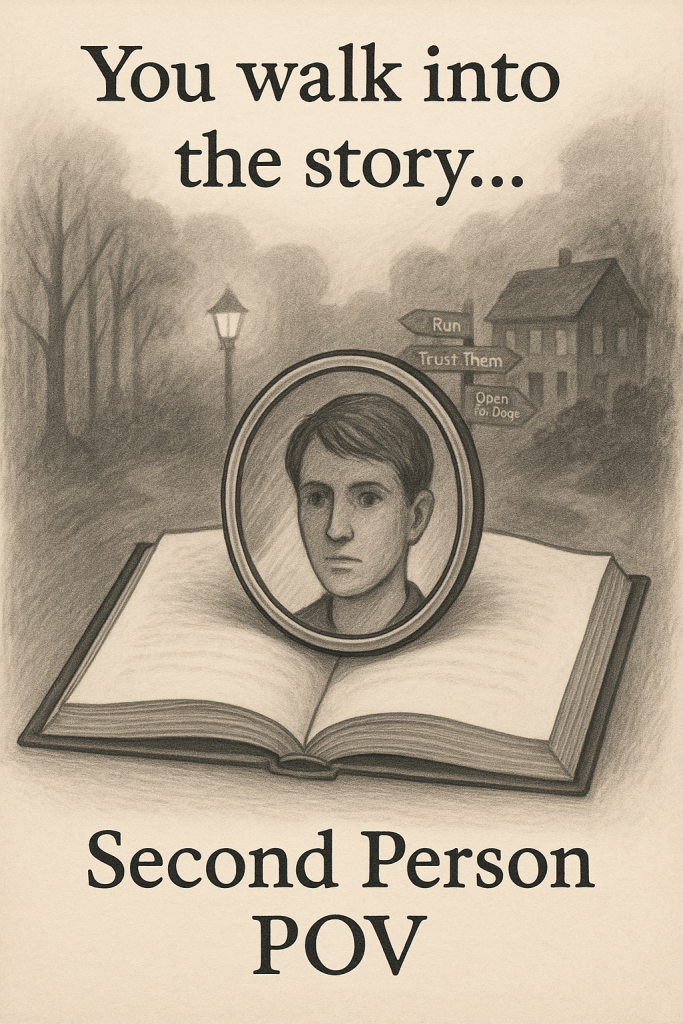
You walk into the story, not as an observer, not as a distant narrator, but as the main character.
Your decisions drive the plot.
Your fears shape the stakes.
Your thoughts echo in every paragraph.
Welcome to the second-person point of view, where you are the story.
What Is Second-Person POV?
In most stories, you follow someone else’s journey. Writing in the second-person, the writer flips the script. It tells the story using the pronoun “you.”
“You wake up in a city you don’t recognize. Your wallet is missing. Someone left a note on the hotel mirror: ‘Don’t trust the concierge.’”
This isn’t a literary gimmick. Done right, second-person creates immersion, tension, and intimacy unlike any other perspective.
How It Works
Second-person POV uses you, your, and yourself. This approach pulls the reader directly into the narrative like a character in a game or a dream.
Second-person POV isn’t exactly mainstream. It’s found in:
- Choose-your-own-adventure books
- Interactive fiction & gaming narratives
- Literary experiments
- Poetry and flash fiction
- Self-help or motivational writing
Sometimes, you’re meant to be yourself. Other times, “you” is a constructed, unnamed character the writer wants you to inhabit. Second-person POV has it’s purpose.
- Immersion: It’s like virtual reality in prose form.
- Style: It’s unusual, bold, and memorable.
- Intimacy: The story speaks to you, not just at you.
- Control: In interactive stories, you guide the plot.
Don’t say that I didn’t warn you. Second person isn’t for the faint of heart. It’s hard to sustain over a long story without fatiguing the reader or losing clarity.
- It can feel forced or unnatural if the reader doesn’t identify with “you.”
- It’s hard to develop deep internal emotions.
- It limits point of view flexibility. There’s no slipping into someone else’s head.
- Second-person shines for short pieces or experimental fiction.
How to Use It Well
To begin, ground the reader in detail. Use sensory cues to keep the story vivid. This way, you can engage the reader by making them a part of the story. Set expectations early by telling the reader who the “you” is. Are they the reader or a fictional character? While it’s tempting to create continuity, avoid repetitive sentence structure. The narrative voice needs to be consistent, confident, and clear, if not “on the nose.”
Second-person POV is a narrative mirror. The reader sees not a good guy, not a bad guy, only themselves caught in a moment.
It’s personal and risky, but if you’re brave, it’s unforgettable.

Do you have questions or comments? Ask Besty Bot about the writing craft and how to publish your book with Best Chance Media!
Copy and Share This Post on Your Social Media:
🔁 Have you ever written in second person? Share your experiments, wins, or fails in the comments. And if you haven’t yet… maybe it’s time you did. #WritingTips #POV #SecondPersonPOV #AmWriting #NarrativeVoice #CreativeWriting #WritersOfInstagram #StorytellingMagic #YouAreTheStory #WritingInspiration https://bestchancemedia.org/2026/03/05/you-walk-into-the-story-writing-in-second-person-pov/


Discover more from Best Chance Media
Subscribe to get the latest posts sent to your email.

