Unlock Immersion: Writing in Second-Person Perspective

By Jennifer Braddock – Editor
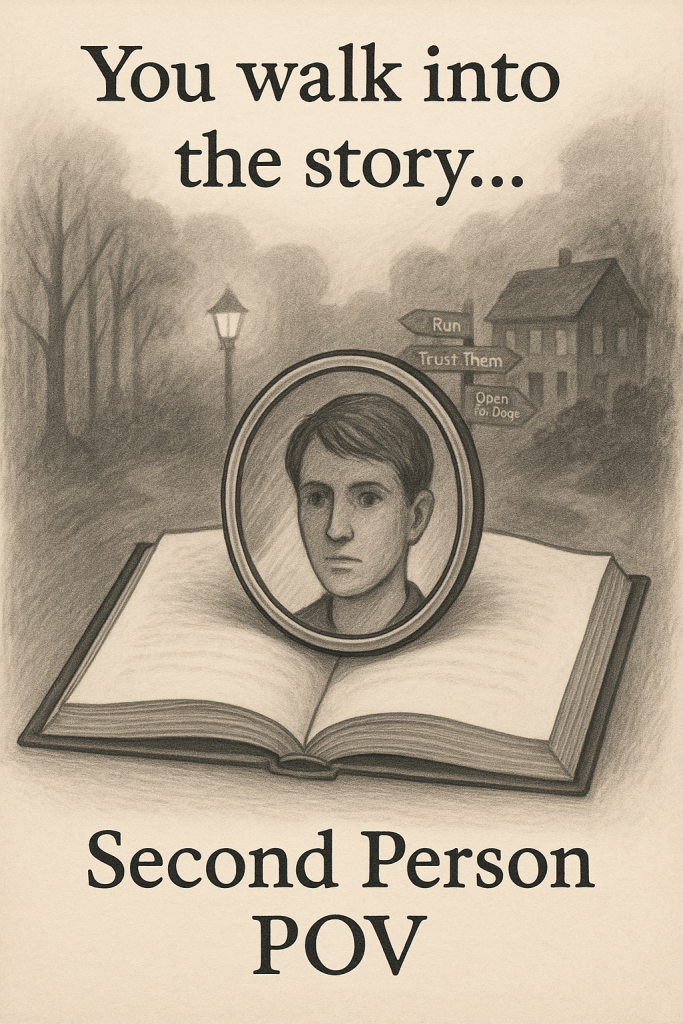

You walk into the story, not as an observer, not as a distant narrator, but as the main character.

Your decisions drive the plot.
Your fears shape the stakes.
Your thoughts echo in every paragraph.

Welcome to the second-person point of view, where you are the story.

What Is Second-Person POV?

In most stories, you follow someone else’s journey. Writing in the second-person, the writer flips the script. It tells the story using the pronoun “you.”

“You wake up in a city you don’t recognize. Your wallet is missing. Someone left a note on the hotel mirror: ‘Don’t trust the concierge.’”

This isn’t a literary gimmick. Done right, second-person creates immersion, tension, and intimacy unlike any other perspective.

How It Works

Second-person POV uses you, your, and yourself. This approach pulls the reader directly into the narrative like a character in a game or a dream.

Second-person POV isn’t exactly mainstream. It’s found in:

  • Choose-your-own-adventure books
  • Interactive fiction & gaming narratives
  • Literary experiments
  • Poetry and flash fiction
  • Self-help or motivational writing

Sometimes, you’re meant to be yourself. Other times, “you” is a constructed, unnamed character the writer wants you to inhabit. Second-person POV has it’s purpose.

  • Immersion: It’s like virtual reality in prose form.
  • Style: It’s unusual, bold, and memorable.
  • Intimacy: The story speaks to you, not just at you.
  • Control: In interactive stories, you guide the plot.

Don’t say that I didn’t warn you. Second person isn’t for the faint of heart. It’s hard to sustain over a long story without fatiguing the reader or losing clarity.

  • It can feel forced or unnatural if the reader doesn’t identify with “you.”
  • It’s hard to develop deep internal emotions.
  • It limits point of view flexibility. There’s no slipping into someone else’s head.
  • Second-person shines for short pieces or experimental fiction.

How to Use It Well

To begin, ground the reader in detail. Use sensory cues to keep the story vivid. This way, you can engage the reader by making them a part of the story. Set expectations early by telling the reader who the “you” is. Are they the reader or a fictional character? While it’s tempting to create continuity, avoid repetitive sentence structure. The narrative voice needs to be consistent, confident, and clear, if not “on the nose.”

Second-person POV is a narrative mirror. The reader sees not a good guy, not a bad guy, only themselves caught in a moment.

It’s personal and risky, but if you’re brave, it’s unforgettable.

Do you have questions or comments? Ask Besty Bot about the writing craft and how to publish your book with Best Chance Media!

Copy and Share This Post on Your Social Media:

🔁 Have you ever written in second person? Share your experiments, wins, or fails in the comments. And if you haven’t yet… maybe it’s time you did. #WritingTips #POV #SecondPersonPOV #AmWriting #NarrativeVoice #CreativeWriting #WritersOfInstagram #StorytellingMagic #YouAreTheStory #WritingInspiration https://bestchancemedia.org/2026/03/05/you-walk-into-the-story-writing-in-second-person-pov/

← Back

Thank you for your response. ✨

Mastering Narrative: Choosing Your Point of View

By Jennifer Braddock – Editor

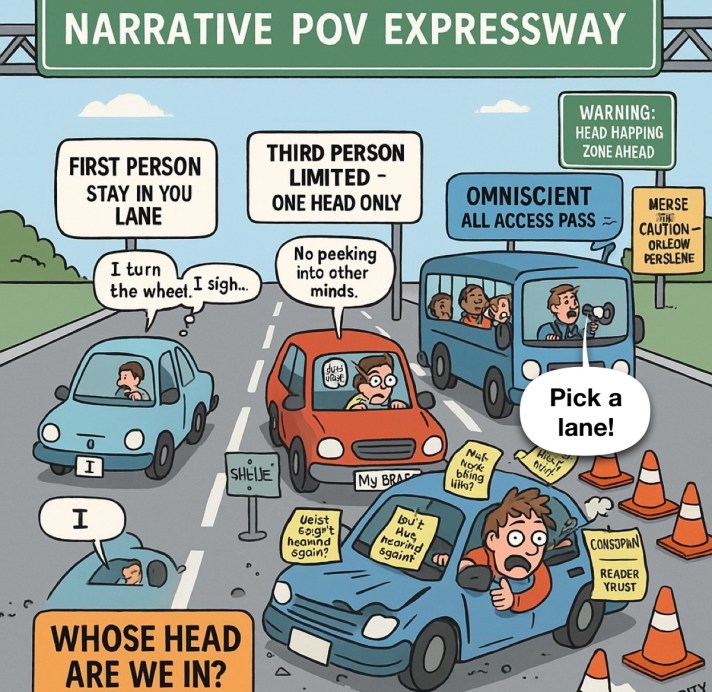
Have you ever been on a road trip where the front seat passenger grabs the wheel? Someone else keeps changing the music. Meanwhile, your pal in the back seat won’t stop criticizing your every turn.

That’s what it feels like when a story hops from one Point of View (POV) to another without a license. Before you take your reader on a narrative joyride, let’s make sure you know who’s driving.

Here’s a breakdown of the most commercially successful, tried-and-true storytelling POV vehicles that publishers and readers love most.

First Person (I, me, my)

Definition: The narrator is the main character, telling the story directly to the reader.
Example: The Catcher in the Rye
Why It Sells: Instant intimacy. We feel like we’re inside the narrator’s brain.
Rules of the Road:

  • Stay in one character’s head per scene, preferably for the entire book.
  • Filter everything through their thoughts, senses, and voice.
  • Avoid describing things your narrator couldn’t possibly know (e.g., what someone else is thinking).
    Bonus Tip: Voice is everything. Even the way they describe the weather should tell us something about them.

Third Person Limited (he, she, they, filtered through one character)

Definition: The narrator is not a character but sticks closely to one of the character’s internal world per scene.
Example: The Da Vinci Code
Why It Sells: It gives the closeness of the first person. It also provides the flexibility to explore scenes your protagonist might not witness.
Rules of the Road:

  • Each scene sticks with one character’s experiences.
  • Use their language and emotional filter when describing the world.
  • Don’t head-hop. Sudden shifts in perspective confuse readers and break trust.

Third Person Omniscient (he, she, they from a godlike narrator’s POV)

Definition: The narrator knows everything and can go into any character’s thoughts, switch locations, and even comment on the story.
Example: Pride and Prejudice
Why It Sells (when done well): Epic scale, sweeping story lines, and a sense of authority.
Rules of the Road:

  • The narrator can dip in and out of minds, but does so with intention and clarity.
  • Don’t confuse omniscience with chaos. Thought transitions should be smooth and purposeful.
  • Voice matters: your narrator should have their own tone or personality.

Second Person (you, your)

Example: Choose Your Own Adventure books
Why It Sells (rarely): When it works, it’s immersive and experimental. When it doesn’t, it’s weird.
Rules of the Road:

  • Be clear who “you” is: the reader, a character, or an implied role.
  • Works best in short doses or highly stylized narratives.
  • Most traditional publishers don’t go for second person unless it’s very well done.

POV Tips

  • Be consistent. Don’t switch POVs mid-paragraph (or mid-sentence unless you’re very good).
  • Establish POV early. Don’t make your reader guess who’s talking or thinking.
  • Change scenes to change heads. If your story uses multiple POVs, give each character their own scene or chapter.
  • Don’t be a mind reader. If your POV character doesn’t know something, neither should the reader.

Choosing a point of view isn’t just about grammar. It’s about control. Like a magician’s sleight of hand, your POV determines what the reader sees, hears, and feels. Before you commit to first, third, or that odd duck known as second person, think carefully. Ask yourself: Whose head am I entering?

Next up: A deeper dive into each POV. We will provide examples and discuss pros and cons. You’ll learn how to know which one is right for your story.


Do you have questions or comments? Ask Besty Bot about the writing craft and how to publish your book with Best Chance Media!

Copy and Paste This on Your Social Media:

🧠 Whose head are we in, anyway? First person, third person limited, omniscient, second person (wait, what?). Your story’s point of view can make or break the reader’s experience. 🚫 No more accidental head-hopping! Learn the most commercially successful POVs and how to wield them like a pro. ✍️ Your narrator’s waiting. Choose wisely. #WhoseHeadAreWeIn
#WritingTips #POVMatters #AmWritingFiction #WritersOfInstagram #StorytellingSkills #HeadHopHorrors #WritingCraft #IndieAuthorTips 🔗 https://bestchancemedia.org/2026/01/15/mastering-narrative-choosing-your-point-of-view/

← Back

Thank you for your response. ✨