
Some novels entertain. Some educate. A rare few refuse to let the reader off the hook.
Vengeance! at Stone Creek is one of those books.
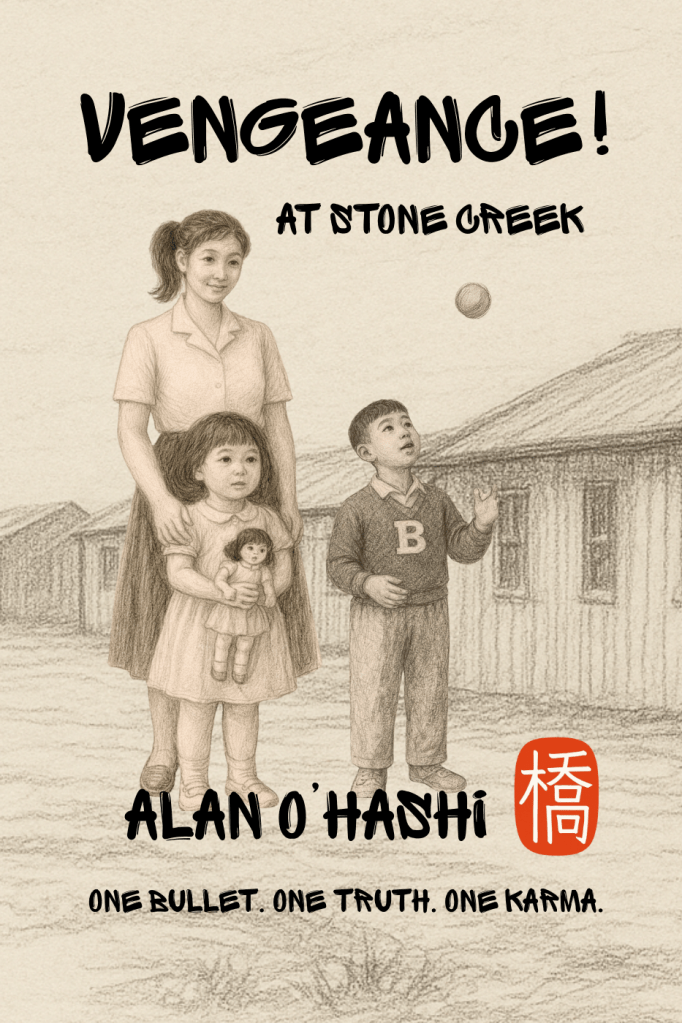
Set in the long shadow of World War II–era Japanese incarceration, the novel explores what happens after injustice has been legalized and filed away.
Rather than retelling history, it integrates unanswered questions and the uncomfortable truth, deferring accountability indefinitely.
Alan O’Hashi writes with restraint and precision. The tension comes from moral pressure and the question history prefers not to ask: What is owed when the harm was sanctioned by law?
When a soldier fires his rifle from a guard tower inside Camp Arroyo, a Japanese American incarceration camp near Stone Creek, Colorado, the sound echoes far beyond the barbed wire.
What happens next is buried under military procedure, fear, and silence. Official reports flatten the truth. Witnesses are discouraged from speaking. Inside the Camp, grief is expected to be swallowed quietly.
Tak Fujiyama is a child when the shots are fired, but the moment marks him for life. Incarcerated alongside his family without trial, Tak learns early that innocence offers no protection and that the law does not always serve justice.
As the War grinds forward, Camp Arroyo becomes its own harsh world of dust storms, guard towers, loyalty questionnaires, and the daily humiliation of being labeled an enemy by the country of his birth. The violence at Stone Creek is never properly addressed, and Tak is left to grow up carrying an unanswered wound.
After the War ends, America moves on quickly.
The WRA dismantled the camps, archived files, and released families with bus tickets. Tak learns that forgetting is the price of belonging. He builds a life beyond the Camp, but memory proves stubborn. The injustice refuses to fade, shaping his relationships, his sense of self, and his understanding of right and wrong.
Years later, unanswered questions draw Tak back to Stone Creek. His past resurfaces through testimony, suppressed records, and the memories of those who survived the Camp’s violence. Tak confronts what was taken from him and others and reckons with a difficult truth. Vengeance feels like the only remaining form of balance.
Vengeance! at Stone Creek is a powerful work of historical fiction that explores the lasting psychological and moral consequences of wartime incarceration. Through Tak’s journey, the novel examines loyalty under pressure, the burden placed on survivors to remain silent, and the generational cost of unresolved trauma. My story illuminates a rarely told chapter of American history, where citizenship failed to protect and the rule of law bent under fear and prejudice.
At its heart, this is a book about memory, who controls it, who benefits from forgetting, and what happens when those harmed refuse to let the truth disappear. Vengeance! at Stone Creek asks hard questions about accountability and justice, and about what remains when a nation chooses expedience. It is a sobering, deeply human novel about the price of silence and the long shadow cast by injustice.
This novel is for readers who loved Snow Falling on Cedars, No-No Boy, or There There, but it stands firmly on its own. It’s spare, deliberate, and quietly furious. The kind of book that sparks hand-selling conversations. The kind readers come back to talk about.
Vengeance! at Stone Creek dropped February 19th and is available for order from your local bookstore. Buy a signed copy or Buy a copy online.
