Exploring Healthcare Misadventures in Reverse

A lifetime of healthcare misadventures, told backwards: Read A Twinkle at the End: Rewinding My Life Through America’s Healthcare Maze now, before the author rewinds completely.

Most memoirs start with childhood and end with death. Author Alan O’Hashi does the opposite: He begins as an old guy on the verge of collapsing in the kitchen. He then works his way backward through Medicare mix-ups, acupuncture torture, and raisin-based arthritis remedies. Finally, Alan fades out as a zygote. Think about cradle-to-grave coverage in reverse.

The story begins with his healthcare in a Boulder, Colorado, senior cohousing community. Read about his acupuncture torture sessions. Discover the drunken raisin arthritis cure that nearly got him evicted from my condo for being too healthy and young.

Along the way, he recounts medical misadventures from my working life. These include a small-town hospital merger. There was also an emergency CPR rescue. From there, it’s a rewind through college scrapes, high school drama, and adolescent sex-ed horrors. There are also grade-school struggles with bad eyesight and worse teeth. Eventually, he vanishes as nothing more than a twinkle in his parents’ eyes.

Of course, there’s a paradox at the heart of all this. Healthcare providers want to keep us alive and well. To survive themselves, they depend on us being just sick enough to keep coming back. Cures don’t pay the bills, chronic conditions do.

According to Social Security, I’ve got about 10.4 years left on my warranty. Given my track record, He hopes to outlive the actuary. If you want to find out how his story unwinds before he does, grab the book now. Don’t wait until he’s a twinkle. There will be no book signings after that.

Order from Ingram iPage, ISBN: 9798218163495, Retail Price $17.99 USD.

Copy and Share this Post on Your Social Media

✨🎄 The holiday season is here, and every purchase has power! When you shop small, you support neighbors, community, and creativity. Local shops work hard to welcome you through their doors. They keep their shelves unique by carrying books and gifts from indie authors and makers. 📚🎁 This December, let’s give back to our communities. We should support shopkeepers and independent creators who make the world brighter. 💡💖 #ShopSmall #SupportLocal #IndieAuthors #HolidayShopping #SupportCreativity #BuyLocal #ReadIndie https://bestchancemedia.org/2025/11/21/exploring-healthcare-misadventures-in-reverse/

Do you have questions or comments? Ask Besty Bot about the writing craft and how to publish your book with Best Chance Media! 

Master Self-Editing Before Hiring an Editor

By Jennifer Braddock – Editor

You typed “The End.” You’re euphoric. You’re exhausted. You’re ready to send your masterpiece off to an editor… but slow your roll, Hemingway. Drafting is just half the job.

Now comes editing. This is the tedious part that turns your messy genius into a manuscript readers won’t want to put down.

Before you hire anyone, give your manuscript a round or three or four of self-editing. You’ll save money, make your editor’s job easier, and catch obvious stuff yourself.

Self-Editing Checklist:

  • Take Your Time: Editing is a slow process. When you find that your mind is wandering. It’s time to stop. Take a break and come back later.
  • Structure: Does the story flow logically? Do scenes build tension? Are character arcs satisfying?
  • Style: Are there overused words or cliches? Do you vary sentence structure?
  • Dialogue: Does it sound natural? Does each character have a distinct voice?
  • Pacing: Are there slow spots or info dumps?
  • Continuity: Are your character’s eyes blue on page 10 and brown on page 200?

Use Tools, Not Crutches

Digital tools can be helpful, but don’t let them write your novel for you. There are limited feature free versions, but do a pretty good job. If you’re reading your words and a historical point doesn’t make sense, cross-check your information. It doesn’t matter if you use an online tool or have people give you notes, you still have to decide whether or not you want to accept the proposed changes. Run your work through these, but read every suggestion critically. Don’t let algorithms rewrite your voice.

Popular Tools:

  • Grammarly: Good for catching spelling and grammar issues, but it can kill your style if you accept every suggestion.
  • ProWritingAid: Offers style suggestions and checks for repetition and readability.
  • AutoCorrect: Great for typos, dangerous if you rely on it blindly. It only catches misspellings, not homonyms.
  • Natural Reader: Text-to-speech is a good way to hear how your words sound. You can edit while you’re listening, then copy your work back into the manuscript.

Know Your Editor Types

Different editors do different things. Hiring the wrong kind is like bringing a plumber to fix your roof.

Types of Editors:

  • Developmental Editor: Big picture stuff, like plot, structure, character arcs.
  • Line Editor: Sentence-level style, flow, and clarity.
  • Copy Editor: Grammar, punctuation, consistency, factual accuracy.
  • Proofreader: The final polish. Typos and formatting only.

When to Hire an Editor

Once you’ve self-edited and maybe gotten beta reader feedback, then it’s time to hire.

Timing Tips:

  • Hire a developmental editor early if you’re unsure about your story structure.
  • Bring in a line editor once the plot is solid and your draft is clean.
  • Use a copy editor before you submit to agents or self-publish.
  • Get a proofreader after layout or formatting is done.

Your Call to Action!
Finishing your first draft feels like crossing the finish line, until you realize you’ve just qualified for the marathon. Treat editing like a vital part of your writing process. It is not a punishment. Then, you’ll come out with a manuscript that actually earns those five-star reviews.

Ready to level up your manuscript? Start with self-edits, test-drive some tools, then find the right editor for your stage. Share this post with your writing group, and let’s raise the editing bar together.

Do you have questions or comments? Ask Besty Bot about the writing craft and how to publish your book with Best Chance Media!

Copy and Share this post to your social media:

📚 You finished your draft—congrats! But don’t hire an editor just yet.
First, self-edit like a boss. Then choose the right editor for the job. Not sure where to start? This post breaks it all down—tools, timing, and types of editors you actually need.✍️
https://bestchancemedia.org/2025/11/20/so-you-think-youre-done-a-writers-guide-to-editing-before-you-hire-an-editor/

#AmEditing #WritingTips #IndieAuthorLife #SelfEditing #EditingTips #Grammarly #ProWritingAid #WritersOfInstagram #WritersCommunity #FinishTheDraft #WritingJourney #HireAnEditor

Go back

Your message has been sent

Warning
Warning
Warning
Warning.

Why Picking a Genre Matters More Than You Think

By Jennifer Braddock – Editor

When I first started reading about query letters, one piece of advice kept popping up: agents and publishers want to know your genre.

At first, I resisted. “My book doesn’t fit into a neat little box,” I thought. “It’s unique!” But here’s the truth: uniqueness and marketability aren’t the same thing.

I’m looking for ‘funky, magical romance’!

Think of it this way. Walk into a bookstore. What do you see? Shelves with clear labels: Mystery, Romance, Science Fiction, Memoir. If your book doesn’t fit neatly under one of those signs, where would a bookseller put it? If readers can’t find your book, or don’t know what to expect when they pick it up, they likely wont buy it.

This isn’t about stifling creativity. It’s about speaking the same language as the people who will help you get your book into readers’ hands. Agents, publishers, and booksellers all use genres as shorthand for understanding your audience.

  • Agents want to know your genre so they can decide if your book fits the kinds of projects they represent. An agent who specializes in romance won’t take on your hard sci-fi novel, even if it’s brilliant.
  • Publishers need genres because they plan book launches around clear categories. If they don’t know whether your book is a historical novel or a thriller, they can’t figure out where to market it, or which editor will champion it.
  • Readers use genre as a promise. When they pick up a mystery, they expect a crime to solve. When they buy a romance, they expect a love story. Delivering on those expectations builds trust and keeps them coming back.

Here’s a simplified way to think about it:

  1. Start broad. Is your book fiction or nonfiction?
  2. Pick a lane. If it’s fiction, is it a mystery, romance, fantasy, historical, or literary novel? If it’s nonfiction, is it memoir, history, self-help, or true crime?
  3. Drill down. Subgenres help narrow your audience. Is your fantasy epic or urban? Is your romance historical or contemporary? Is your memoir a travel memoir or a grief memoir?

Here’s the most important part: be strategic. Query agents and publishers who actually represent or publish your genre. If you have a unique hybrid subgenre, position it smartly in your query letter or pitch.

For example, you might describe your book as “a mystery with speculative elements” rather than forcing an agent to wrestle with a brand-new label. If you spend too much time explaining why your work is part this and part that, you risk sounding uncertain—and uncertainty is the fastest way to lose interest.

Another tip: think about genre before you start writing. Rather than pouring your heart into a draft and then pulling your hair out trying to shoehorn it into a category later, give yourself a boundary from the beginning. Boundaries aren’t restrictions; they’re frameworks. Knowing your story is a thriller, a romance, or a memoir helps guide your choices as you write and keeps you from drifting so far that your story doesn’t fit anywhere.

Once you know your category, you can find comp titles—books that are similar to yours in tone, audience, or subject. Comp titles aren’t about proving your book is unoriginal; they show agents, publishers, and readers where your book fits in the marketplace and why it belongs on the shelf.

So, yes, your book might straddle genres, but for the sake of selling it, you need to pick one primary genre and maybe a subgenre. Think of it as giving your book a home. After all, if you don’t know where to shelve it, how will anyone else?

Call to Action: The next time you sit down to write—or revise—ask yourself: What shelf would my book sit on in a bookstore? Start there, and you’ll save yourself countless headaches when it’s time to query, pitch, and ultimately connect with readers who are already waiting for a story just like yours.

Crafting an Irresistible First Page Hook

By Jennifer Braddock – Editor

There’s an old saying in publishing: Your first page sells the book. The last page sells your next book.

In an era where readers are bombarded with e-books, podcasts, and streaming shows, capturing attention is a challenge.

Social media and endless repeats further add to the clutter. You have only seconds to convince consumers that your story is worth their time.

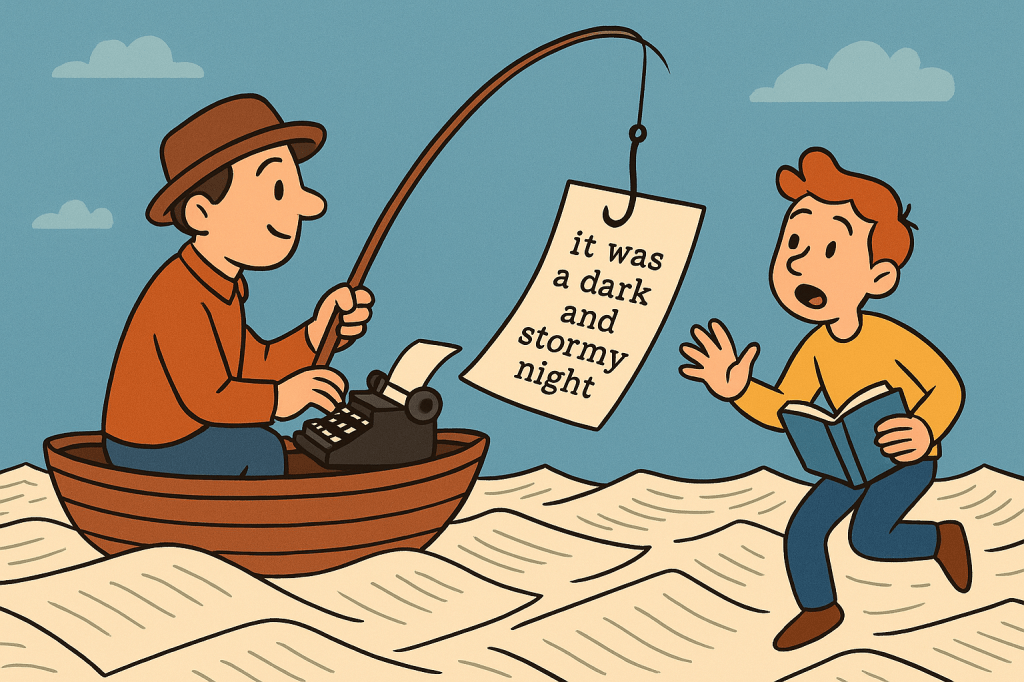
Beginning your first page with a catchy first line is critically important.

Whether you’re writing a novel, a memoir, or a short story, the first line is your golden handshake. It’s your sales pitch and your mood-setter all in one.

“An opening line should invite the reader to begin the story,” is what Stephen King said. Your first line sets the tone for the first page that needs to glow like a tended ember.

Why the First Page Matters: A casual bookstore browser will flip open your book and read a paragraph. That’s when they decide whether to walk to the cash register or put it back on the shelf. Agents and editors? They’re more ruthless. They read so many bad stories that they know within a few sentences whether a manuscript is worth further reading.

The first page has a tall order to fill. Be sure you:

  • Grab attention immediately.
  • Establish tone and voice.
  • Offer a sense of the world or situation.
  • Make the reader curious enough to keep turning pages.

Done well, it’s like smoldering cedar. Readers can’t help but follow where you’re leading them.

The Anatomy of a First Page Hook: Think of the first page as having three layers.

First Line, The Spark: This is your ignition switch. It can be shocking, funny, mysterious, or emotionally intense. Its job is to make the reader think, I need to know more.

  • A startling statement: “The day my sister stopped speaking to me began like any other.”
  • A curious image: “By the time the cat arrived, the rain had already soaked the bread on the windowsill.”
  • A direct challenge: “Everything they told you about the fire was a lie.”

First Paragraph, The Tone-Setter: The first paragraph expands the spark into a flame. Here you introduce voice, hint at stakes, and begin to reveal the world your characters inhabit. It should answer at least one question: Who’s talking? Where are we? What’s happening right now? Leave enough mystery to keep readers moving forward.

First Page, The Invitation: By the end of page one, you want the reader emotionally invested in your bonfire. You also want them intellectually invested.

  • Introduce a compelling character, situation, or problem.
  • Show enough personality or atmosphere to suggest what kind of journey this will be.
  • End with momentum, like a small cliffhanger, a hint of danger, or a hanging question.

Novels vs. Memoirs Hooks: I write memoirs and historical fiction. I’m most familiar with those. Hooks are always similar.

Similarities:

  • Both need to hook readers quickly.
  • Both benefit from strong voice, vivid detail, and a clear emotional tone.

Differences:

  • Novels have total freedom to invent the most dramatic and intriguing moments. They can start even if it’s chronologically later in the story.
  • Memoirs are bound to truth, but that doesn’t mean you must start at the very beginning. You can still open in the middle of a pivotal moment in your life and then work backward or forward.
  • Memoirs rely heavily on voice. The reader needs to feel they are in good hands. The storyteller must know how to make even an ordinary moment compelling.

For a memoir, think of the first page as a promise to the reader: “Yes, this really happened. Yes, it matters. And yes, you’ll be glad you came along for the ride.”

Does Point of View Affect the Hook? Absolutely. Your POV choice shapes the intimacy, immediacy, and style of the hook.

First Person (“I”):

  • Pros: Instant intimacy. Great for memoirs and deeply character-driven fiction. Let’s readers step directly into the narrator’s mind.
  • Cons: Can feel claustrophobic if the narrator’s voice isn’t strong or likable.

Close Third Person (“he/she/they” with access to thoughts):

  • Pros: Offers intimacy with flexibility to move between inner thoughts and outward action.
  • Cons: Can be harder to establish a strong voice right away compared to first person.

Omniscient Third Person (all-knowing narrator):

  • Pros: Sweeping scope, ability to set a large stage, and add irony or commentary.
  • Cons: Can feel distant unless anchored in vivid, specific sensory details.

Is there a best POV for a hook? POV effectiveness depends on your story’s tone and emotional core. For maximum impact on page one, use a closer POV. A first or close third-person perspective helps the reader bond quickly with your narrator or main character. Here are examples of effective hooks.

Novel: “It was a bright cold day in April, and the clocks were striking thirteen.” (1984, George Orwell)

There’s an unsettling detail (clocks striking thirteen) that immediately signals that something is off in this world.

Memoir: “In our family, there was no clear line between religion and fly fishing.” (A River Runs Through It, Norman Maclean).

This works because the voice and juxtaposition make you want to know more about this family.

A First-Page Structure Template: Here’s a quick checklist you (or your blog readers) can keep nearby:

First Line:

  • Intriguing image, surprising fact, or emotionally charged statement.

First Paragraph:

  • Establish tone and voice.
  • Ground the reader in time/place without over-explaining.

First Page:

  • Introduce a character or situation.
  • Hint at stakes or tension.
  • End with something unresolved.

Final Thoughts and a Challenge: Writing a great hook is part art, part craft. The art is in knowing what emotional note you want to strike. The craft is in revising until every word earns its place.

Write three completely different first pages for the same story idea. One in first person, one in limited third, and one starting deep in the action. Read them aloud. See which one makes you most eager to keep going. Chances are, that’s the one that will work on your readers too.

Your hook’s job is simple: make readers turn the page. If you do that, you’ve already won half the battle.

Do you have questions or comments? Ask Besty Bot about the writing craft and how to publish your book with Best Chance Media!

Copy and Share this Post on your Social Media:

📚 Your first page isn’t just an introduction, it’s your audition.
Whether you’re writing a novel or a memoir, the hook is your handshake. It is your invitation and your promise to the reader. In my latest blog post, I break down:

  • What makes a killer first page
  • How memoir hooks differ from fiction
  • Why POV changes the impact of your opening line

Copy and Share this Post on Your Social Media

✨ Don’t just start your story, ignite it. #AmWriting #WritingTips #WritersLife #WritingCommunity #AmEditing #Storytelling #BookMarketing #IndieAuthor #NovelWriting #MemoirWriting #WritersOfInstagram #AuthorLife #FictionWriting #WritingAdvice #POVWriting #FirstPageHook #ReadersLife

Go back

Your message has been sent

Warning
Warning
Warning
Warning.

Black & Tan Episode 6 – the last one: Did you gain any insights?

https://www.podbean.com/media/share/pb-fa7nn-18e6fee

This is the last episode of the season. We talked about bridging social and economic divides by thinking about how you might have acquired biases and preconceived notions about people unlike yourself. We suggested ways to unwind those recordings in your head to be more accepting of others. Rather than entrenching into our attitudes and beliefs, what can we do to get out of our ruts?