Vengeance! at Stone Creek: The Executive Order That Never Ended

Some novels entertain. Some educate. A rare few refuse to let the reader off the hook.

Vengeance! at Stone Creek is one of those books.
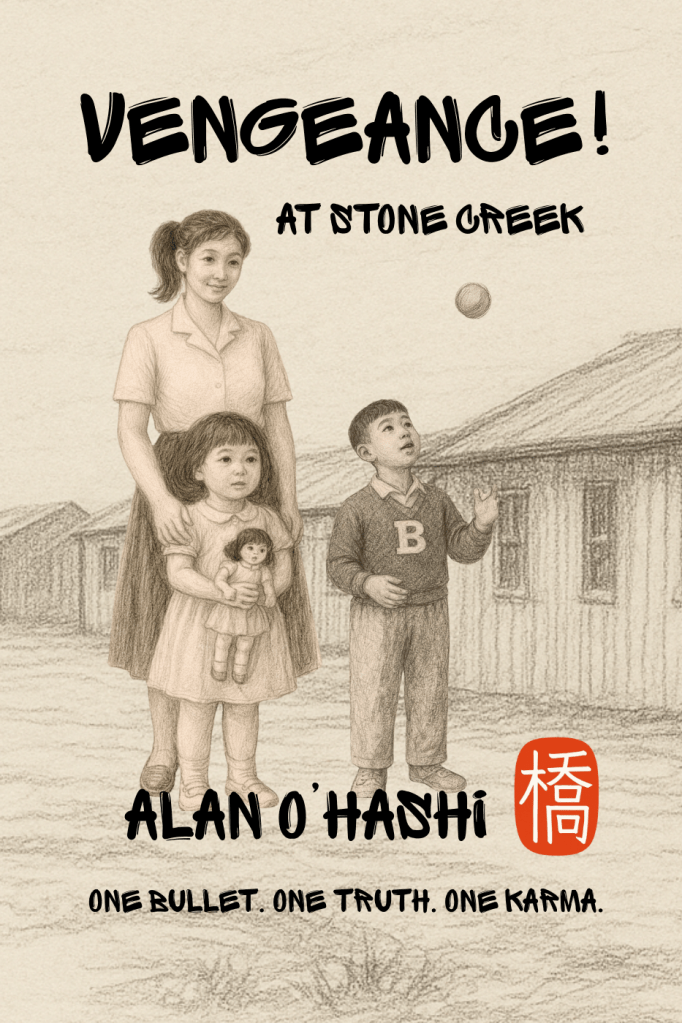
Set in the long shadow of World War II–era Japanese incarceration, the novel explores what happens after injustice has been legalized and filed away.

Rather than retelling history, it integrates unanswered questions and the uncomfortable truth, deferring accountability indefinitely.

Alan O’Hashi writes with restraint and precision. The tension comes from moral pressure and the question history prefers not to ask: What is owed when the harm was sanctioned by law?

When a soldier fires his rifle from a guard tower inside Camp Arroyo, a Japanese American incarceration camp near Stone Creek, Colorado, the sound echoes far beyond the barbed wire. 

What happens next is buried under military procedure, fear, and silence. Official reports flatten the truth. Witnesses are discouraged from speaking. Inside the Camp, grief is expected to be swallowed quietly.

Tak Fujiyama is a child when the shots are fired, but the moment marks him for life. Incarcerated alongside his family without trial, Tak learns early that innocence offers no protection and that the law does not always serve justice.

As the War grinds forward, Camp Arroyo becomes its own harsh world of dust storms, guard towers, loyalty questionnaires, and the daily humiliation of being labeled an enemy by the country of his birth. The violence at Stone Creek is never properly addressed, and Tak is left to grow up carrying an unanswered wound.

After the War ends, America moves on quickly.

The WRA dismantled the camps, archived files, and released families with bus tickets. Tak learns that forgetting is the price of belonging. He builds a life beyond the Camp, but memory proves stubborn. The injustice refuses to fade, shaping his relationships, his sense of self, and his understanding of right and wrong.

Years later, unanswered questions draw Tak back to Stone Creek. His past resurfaces through testimony, suppressed records, and the memories of those who survived the Camp’s violence. Tak confronts what was taken from him and others and reckons with a difficult truth. Vengeance feels like the only remaining form of balance.

Vengeance! at Stone Creek is a powerful work of historical fiction that explores the lasting psychological and moral consequences of wartime incarceration. Through Tak’s journey, the novel examines loyalty under pressure, the burden placed on survivors to remain silent, and the generational cost of unresolved trauma. My story illuminates a rarely told chapter of American history, where citizenship failed to protect and the rule of law bent under fear and prejudice.

At its heart, this is a book about memory, who controls it, who benefits from forgetting, and what happens when those harmed refuse to let the truth disappear. Vengeance! at Stone Creek asks hard questions about accountability and justice, and about what remains when a nation chooses expedience. It is a sobering, deeply human novel about the price of silence and the long shadow cast by injustice.

This novel is for readers who loved Snow Falling on Cedars, No-No Boy, or There There, but it stands firmly on its own. It’s spare, deliberate, and quietly furious. The kind of book that sparks hand-selling conversations. The kind readers come back to talk about.

Vengeance! at Stone Creek drops February 19th. Buy a signed copy.

Vengeance! at Stone Creek: A Novel of Injustice

Some novels entertain. Some educate. A rare few refuse to let the reader off the hook.

Vengeance! at Stone Creek is one of those books.

Set in the long shadow of World War II–era Japanese incarceration, the novel explores what happens after injustice has been legalized and filed away.

Rather than retelling history, it integrates unanswered questions and the uncomfortable truth, deferring accountability indefinitely.

Alan O’Hashi writes with restraint and precision. The tension comes from moral pressure and the question history prefers not to ask: What is owed when the harm was sanctioned by law?

When a soldier fires his rifle from a guard tower inside Camp Arroyo, a Japanese American incarceration camp near Stone Creek, Colorado, the sound echoes far beyond the barbed wire. 

What happens next is buried under military procedure, fear, and silence. Official reports flatten the truth. Witnesses are discouraged from speaking. Inside the Camp, grief is expected to be swallowed quietly.

Tak Fujiyama is a child when the shots are fired, but the moment marks him for life. Incarcerated alongside his family without trial, Tak learns early that innocence offers no protection and that the law does not always serve justice.

As the War grinds forward, Camp Arroyo becomes its own harsh world of dust storms, guard towers, loyalty questionnaires, and the daily humiliation of being labeled an enemy by the country of his birth. The violence at Stone Creek is never properly addressed, and Tak is left to grow up carrying an unanswered wound.

After the War ends, America moves on quickly.

The WRA dismantled the camps, archived files, and released families with bus tickets. Tak learns that forgetting is the price of belonging. He builds a life beyond the Camp, but memory proves stubborn. The injustice refuses to fade, shaping his relationships, his sense of self, and his understanding of right and wrong.

Years later, unanswered questions draw Tak back to Stone Creek. His past resurfaces through testimony, suppressed records, and the memories of those who survived the Camp’s violence. Tak confronts what was taken from him and others and reckons with a difficult truth. Vengeance feels like the only remaining form of balance.

Vengeance! at Stone Creek is a powerful work of historical fiction that explores the lasting psychological and moral consequences of wartime incarceration. Through Tak’s journey, the novel examines loyalty under pressure, the burden placed on survivors to remain silent, and the generational cost of unresolved trauma. My story illuminates a rarely told chapter of American history, where citizenship failed to protect and the rule of law bent under fear and prejudice.

At its heart, this is a book about memory, who controls it, who benefits from forgetting, and what happens when those harmed refuse to let the truth disappear. Vengeance! at Stone Creek asks hard questions about accountability and justice, and about what remains when a nation chooses expedience. It is a sobering, deeply human novel about the price of silence and the long shadow cast by injustice.

This novel is for readers who loved Snow Falling on Cedars, No-No Boy, or There There, but it stands firmly on its own. It’s spare, deliberate, and quietly furious. The kind of book that sparks hand-selling conversations. The kind readers come back to talk about.

Why indie bookstores should carry it:

Because this is exactly the kind of book your customers expect from you. The stories they won’t discover through algorithms or celebrity lists. This story rewards thoughtful readers by inviting dialogue.

Vengeance! at Stone Creek is available this February. Recommend it. Put it in the hands of readers who want comfort and the truth. Order from Ingram iPage, 979-8-9894213-1-2, Retail Price $19.95 USD.

← Back

Thank you for your response. ✨

Writing Authentic Characters: Tips for Diverse Voices

By Jennifer Braddock – Editor

You’re staring at the page. Your character is taking shape. She could be a young Black woman in the 1940s or a Native teen today. He might be a transgender man in a small town.

Another possibility is an undocumented immigrant or an octogenarian Buddhist monk. And you? You’re none of those things.

Now what?

Writing across difference isn’t a literary crime, but doing it poorly might land you in stereotype prison.

Tokenism, or flattening a character’s identity to a label can sink your story and your credibility. There are ways to do it well, starting with craft.

Why “Show, Don’t Tell” Matters Here

“Show, don’t tell” isn’t just a workshop cliché. It’s a tool that helps writers step back and let the character live on the page. This avoids reducing them to what the writer says about them. For writers working outside their own identity or experience, this approach encourages depth, empathy, and individuality.

Tip 1: Let Identity Inform, Not Define the Character

Telling (weak):
Enrique was a fiery Mexican teenager who loved tacos and got into trouble at school.

Showing (stronger):
Enrique smoothed the foil around his mother’s tamales before shoving them into his backpack. Detention could wait. He wasn’t missing Mrs. Larsen’s pop quiz again.

Enrique’s cultural background shows up in specific details, like tamales and his family life, not broad generalizations. He’s a fully realized teen, not a cultural shorthand. His description moves the story forward.

Tip 2: Think “Person First, Context Always”

Build a whole person with desires, fears, and contradictions. Then think about how identity interacts with the setting. Determine how this person’s lived experience would affect how they move through the world.

Example (White writer writing a Black woman character): Rather than start with “she’s Black.” Start with: What does she want? What’s in her way? Now, how might her identity shape those obstacles or motivations in her world? Think about yourself. Show her neighborhood, places she shops, and the type of food she eats.

Tip 3: Dialogue Should Reveal, Not Reinforce

Avoid using dialogue to dump identity markers or, worse, exoticize. Instead, use tone, pacing, subtext, and conflict. Let dialogue express worldview, not stereotypes.

Bad:
I’m just a sassy Black woman. That’s how we are.

Better:
“You think I’m being loud? No, baby. I’m being heard.”

Tip 4: Use Specificity, Not Symbols

Instead of vague references like “traditional food” or “foreign dress,” use concrete sensory detail. That’s where lived humanity shows up.

Weak:
Josef wore tribal garb.

Stronger:
Josef adjusted the frayed kente sash around his shoulders, fingers brushing the embroidery his grandmother stitched before the War.

Tip 5: Research Isn’t Optional, but It’s Not the End

Read memoirs, essays, and novels by writers who share your character’s identity. Watch documentaries. You might want to visit places where you may feel uncomfortable. Talk to sensitivity readers. Remember, your goal isn’t to become that person, it’s to write one honestly and specifically.

Tip 6: Observe, Embed, and Be Introduced

Writing characters unlike yourself isn’t just about what you imagine. It’s also about what you witness.

  • Observe the real world: Listen to conversations in public spaces. Watch how people interact with their families, elders, and institutions. What are the unspoken rules? What’s considered rude, tender, or powerful?
  • Embed when you can: Attend community events. Be respectful. Volunteer. Sit in the back row of the church, the cultural festival, the open mic, to listen and watch.
  • Find a Cultural Broker: This is someone who’s part of the community you want to write about. They can help you understand the nuance behind what you see. A good broker doesn’t just answer questions; they offer perspective, correct your assumptions, and challenge your narrative where needed.

Quick “Show, Don’t Tell” Checklist

You can’t shortcut trust. You can’t Google your way to nuance. You can build it with time, humility, and intention.

  • Avoid generic labels (e.g., “Asian values,” “female intuition”).
  • Don’t make identity the only thing interesting about a character.
  • Let the character surprise you and your reader.

Writing Outside Your World Requires Courage, Craft, and Cultural Competency

Writing characters unlike yourself isn’t just an act of imagination. It’s an act of responsibility. It’s more than about checking a diversity box. It’s about deepening your empathy, expanding your narrative lens, and doing the labor to write truthfully, not just “accurately.” To do it well, you need more than facts and feedback. You need cultural humility.

That means:

  • Reflecting on your own socialization: What assumptions were you taught about other cultures, races, genders, or communities? What did your education, media, or upbringing fail to show you, or distort?
  • Unlearning harmful patterns: Even well-meaning writers carry unconscious bias. That doesn’t make you irredeemable. It makes you human. But it does mean that part of your job is to interrogate the lens you’re writing through.
  • Expanding your empathy: True cultural competency isn’t performative. It’s about developing the emotional and intellectual agility to fully imagine others. This includes considering them with nuance, contradiction, and depth.

Your Call to Action

The toughest character of all is yourself. You can’t write what you haven’t taken the time to understand. If you’re going to write across race, gender, or ability, start with your own identity.

  • Reflect deeply and be curious.
  • Undo what needs unlearning in addition to research.
  • Listen harder than you speak.
  • Write with humility, not authority, and earn the right to tell the story.

Great storytelling doesn’t just represent the world. It reimagines who belongs in it. Write boldly and responsibly. You can do it. But don’t expect it to be easy. The words you put on the page will shape how readers see the world and each other.

Ready to do the work? Your story deserves it. So do your characters.

Do you have questions or comments? Ask Besty Bot about the writing craft and how to publish your book with Best Chance Media!

Copy and Share This Post to Your Social Media:

✍️ Writing characters unlike yourself? It’s not just about research. It’s about reflection. Undo bias. Observe deeply. Write with cultural humility. Representation starts with responsibility. #AmWriting #WritingTips #DiverseVoices #ShowDontTell #OwnVoices #CulturalCompetency #WritersLife #WriteResponsibly #EmpathyInWriting #WritingCommunity https://bestchancemedia.org/2025/10/01/writing-beyond-stereotypes-tips-for-authentic-character-voices/

← Back

Thank you for your response. ✨

Reimagining Superman’s American Way for a Multicultural Future

Reimagine the American Way and learn ways to bridge multicultural divides in an ever-changing world

What does “Superman’s American Way” mean in today’s multicultural world? Views from Beyond Metropolis: True Stories of a Japanese American Baby Boomer challenges readers to think deeply about that question.

Superman’s origin story as an undocumented immigrant from another planet had a powerful influence on the author’s life. The Man of Steel championed the downtrodden. He valued inclusion over exclusion. He also wrestled with his own obstacles as an outsider trying to belong.

This memoir follows those themes. It demonstrates how lessons from a fictional hero can inform real-world strategies for cultural competency. These lessons also foster resilience.

The author’s family lived outside the West Coast exclusion zone. This zone sent 120,000 Japanese Americans to incarceration camps. They were not spared the burden of racism. They grew up in Cheyenne, Wyoming’s once-vibrant Japanese neighborhood. They encountered both subtle and overt discrimination.

This discrimination persisted long after the attack on Pearl Harbor. Those personal experiences form the heart of the book. They are presented alongside broader reflections on America’s history of legalized oppression. This includes events from slavery and westward expansion to the incarceration of Japanese Americans during World War II.

It asks: What can we learn from the experiences of those who endured racism codified into law? How can that knowledge guide us toward building stronger, more inclusive communities?

Views from Beyond Metropolis is both a memoir and a manifesto. It is a call to see through Superman’s eyes. It encourages us to imagine a future where differences are a strength.

Why This Book Matters

Views from Beyond Metropolis reframes Superman’s immigrant outsider story. It does so through a powerful memoir that blends cultural history with personal experience. The memoir also offers practical tools for bridging divides.

Polarization dominates headlines today. This book offers readers practical ways to recognize bias. It helps cultivate empathy and promote inclusion in their own lives. The narrative connects America’s past to its present-day struggles.

It spans from slavery and westward expansion to Japanese American incarceration during WWII. The book reimagines “The American Way” as one of collaboration and shared humanity.

This book offers both relevance and shelf appeal. It is perfect for readers of memoir and cultural history. It also appeals to those interested in social justice and even superhero mythology.

Order a signed copy from the author.

Order wholesale from Ingram iPage, ISBN: 9798989421329, Retail Price $19.95 USD

Do you have questions or comments? Ask Besty Bot about the writing craft and how to publish your book with Best Chance Media! 

Copy and Share this Post on Your Social Media

🦸‍♂️ What does Superman’s American Way mean in today’s divided world? 📖 Views from Beyond Metropolis: True Stories of a Japanese American Baby Boomer blends memoir, history, and cultural insight—reframing the Man of Steel’s outsider story into practical lessons for building empathy and inclusion. 🌍✨ From slavery to Japanese American incarceration during WWII, this book connects the past to today’s struggles and offers everyday tools for bridging divides. 💡🤝 Perfect for fans of memoir, cultural history, social justice, and even superhero mythology. 🦸‍♀️📚 #ViewsFromBeyondMetropolis #BookOfTheMonth #IndieBooks #Memoir #CulturalHistory #SocialJustice #Superman #InclusionMatters #ReadIndie #Bookstagram https://bestchancemedia.org/2025/09/25/views-from-beyond-metropolis/

← Back

Thank you for your response. ✨